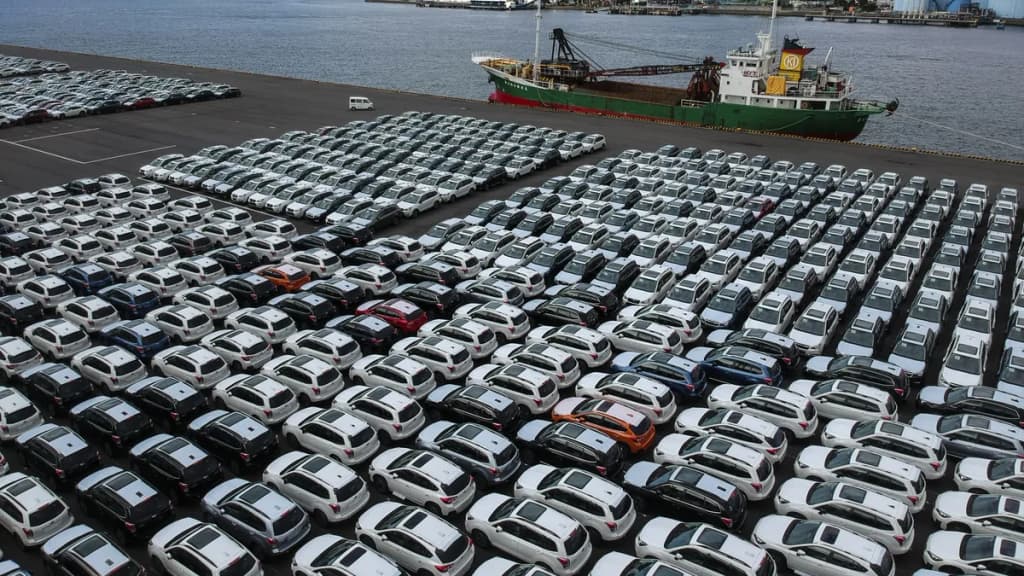
A Japanese automaker is a corporation headquartered in Japan that manufactures vehicles for global export, relying heavily on foreign exchange rates and international supply chain stability to maintain profitability. The current landscape for industry leaders like Toyota, Honda, and Nissan is defined by two primary risks: the potential for a strengthening yen and the ongoing conflict in the Middle East.
At Groundwork, our analysis shows that Japanese automotive earnings are highly sensitive to currency fluctuations. For every 1% appreciation of the yen against the dollar, operating profit for major automakers often declines by 2% to 4%, depending on the company's specific export-to-production ratio. This sensitivity creates a precarious margin for error when governments intervene in currency markets.
Automakers in Japan operate on a model where a weak yen serves as a competitive advantage by making exported vehicles cheaper in foreign currencies and increasing the value of overseas earnings when repatriated. When the Japanese yen reaches historic lows, such as the 40-year lows observed near 163 per dollar, manufacturers see a significant boost in their quarterly operating margins. However, this reliance creates a structural vulnerability to government intervention.
When the U.S. Treasury and Japan’s Ministry of Finance coordinate yen-buying interventions to stabilize the currency, they inadvertently erode the profit margins of these manufacturers. A stronger yen forces executives into a difficult strategic dilemma: either raise vehicle prices in foreign markets—risking a loss of market share to international competitors—or absorb the currency impact, which directly compresses operating profit. According to research from Bernstein, the sensitivity of these firms is profound, with some manufacturers experiencing a 4% hit to operating profit for every 1% shift in currency value.
Geopolitical instability in the Middle East, particularly the ongoing war involving Iran, acts as a major swing factor for logistics and raw material procurement. The Strait of Hormuz and the Red Sea serve as vital shipping arteries for the transport of raw materials essential to automotive manufacturing, including aluminum, steel, and petrochemical derivatives.
At Groundwork, we observe that the conflict creates a dual pressure: increased shipping costs due to maritime insecurity and inflationary spikes in the price of key inputs. Naphtha and resins, which are heavily dependent on oil pricing, have become increasingly volatile. When supply chain logistics are disrupted, the resulting delays and increased insurance premiums for cargo ships eventually filter down to the assembly line, raising the cost of goods sold (COGS) and squeezing the already thinning margins of major auto brands.
Keep exploring
More from GroundworkBeyond the logistics of shipping, the broader inflationary environment is driven by the rising cost of industrial metals and technology components. The production of a modern vehicle requires a steady supply of copper, aluminum, steel, and semiconductor memory chips. As Middle Eastern conflict drives energy prices higher, the energy-intensive process of refining these raw materials becomes more expensive.
Bernstein analysts have noted that inflation across these key inputs is having a broad-based negative impact on industry profitability. Because automakers often operate on long-term contracts for materials, there is a lag between global commodity price spikes and the realization of these costs on balance sheets. Investors should monitor the quarterly reports of these firms specifically for commentary on "raw material cost mitigation" and "hedging strategies" to determine how well these companies are insulating themselves from these shocks.
Assessing the health of a Japanese automaker requires looking beyond simple revenue growth. Investors should evaluate three specific metrics: the company’s currency hedging ratio, its regional production footprint, and its exposure to Middle Eastern shipping lanes. A company that produces a larger percentage of its vehicles within the markets where they are sold—a strategy known as "local production for local consumption"—is generally more resilient to yen volatility than a company that relies heavily on exports from Japan.
Furthermore, Groundwork’s research framework suggests that diversification of the supply chain is the most effective hedge against geopolitical risk. Automakers that have successfully diversified their raw material sourcing away from regions dependent on Middle Eastern shipping lanes are better positioned to withstand prolonged periods of conflict. When conducting your own analysis, look for disclosures regarding "geographical production ratios" and "supply chain resilience programs" in the company’s annual 10-K or equivalent filings.
If you hold equity in Japanese automakers, you must track currency intervention news and commodity price indices closely. First, monitor the monthly statements from the Bank of Japan and the Ministry of Finance, as these are the primary drivers of currency-related volatility. Second, track the price of Brent crude oil and industrial aluminum, as these serve as leading indicators for the input costs that will appear on the next two quarters of financial statements. Finally, evaluate the company's "operating profit sensitivity to exchange rates"—a figure often disclosed in investor relations presentations—to quantify exactly how much your investment might fluctuate during periods of yen appreciation.