Market volatility is a statistical measure of the dispersion of returns for a given security or market index. When implied volatility is low, it indicates that market participants expect prices to remain relatively stable in the near term, reflecting a broader consensus that current risks are either manageable or already priced into existing asset valuations.
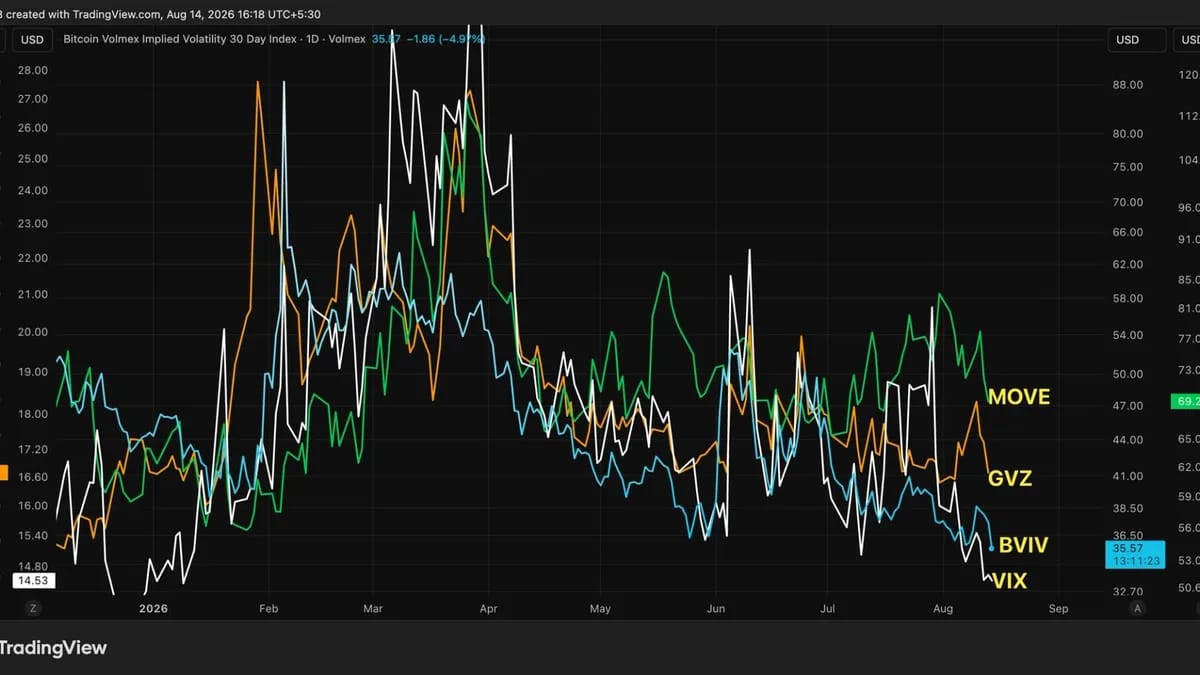
Recent data shows a synchronized decline in implied volatility across major asset classes, including bitcoin, the S&P 500, Treasury bonds, and commodities. Despite persistent geopolitical tensions—such as U.S.-Iran escalation risks—and macroeconomic concerns regarding sovereign debt levels, investors are increasingly choosing to hold positions rather than hedge against sudden, sharp price movements (TradingView, 2026).
Implied volatility is a forward-looking metric derived from the pricing of options contracts, representing the market's expectation of future price swings. It serves as a "fear gauge" because options premiums increase when traders are willing to pay more for protection against potential downside risk or extreme price turbulence.
When implied volatility drops, it suggests that the cost of hedging is decreasing. This occurs when market participants believe that the range of potential outcomes is narrowing. According to financial theory, markets are efficient, meaning that current asset prices already incorporate all available information. Therefore, the current decline in volatility indexes—such as the VIX for stocks and the MOVE index for Treasury bonds—suggests that investors have largely discounted the risks of geopolitical conflict and rising debt (CoinDesk, 2026).
Volatility indexes are currently trending toward the lower end of their historical ranges for 2026, signaling a period of broad market complacency. Bitcoin’s 30-day implied volatility index (BVIV) has retreated to levels near 36%, reversing a brief spike observed earlier in the week. This trend is mirrored in traditional financial markets as well.
Wall Street’s VIX index, which tracks expected volatility in the S&P 500, has reached its lowest point since January 2026. Similarly, the MOVE index—the Treasury market’s equivalent of the VIX—is hovering near the bottom of its multi-month range. Even assets typically used as safe havens, such as gold and oil, are seeing their respective volatility metrics decline. This synchronized calm is notable given that sovereign debt levels remain a primary concern for institutional investors globally (CNBC, 2026).
Keep exploring
More from GroundworkLow market volatility is often interpreted as a sign of stability, but contrarian investors view it as a potential precursor to sudden market corrections. From a technical perspective, periods of prolonged calm can lead to excessive leverage, as traders become comfortable with the lack of price movement and increase their exposure to riskier assets.
If you are an investor, you should distinguish between a lack of volatility and a lack of risk. Geopolitical events, such as international sanctions or sudden shifts in regulatory policy, can act as "black swan" events that trigger rapid repricing. While the current market environment appears sanguine, the underlying risks—including regulatory uncertainty in the crypto sector and rising bond yields—remain present. Relying solely on low volatility indexes can leave a portfolio vulnerable to sudden shocks if market sentiment shifts rapidly.
To manage your portfolio during periods of low volatility, focus on maintaining your long-term asset allocation rather than attempting to time market shifts. Because low volatility often precedes periods of increased uncertainty, your primary goal should be to ensure that your risk exposure remains consistent with your original investment objectives.
- Review your current asset allocation: Ensure that your portfolio is still balanced according to your risk tolerance, as low volatility can sometimes mask over-concentration in specific sectors.
- Reassess your hedging strategy: If you hold options to protect your portfolio, evaluate whether the current lower premiums offer an affordable opportunity to "buy" insurance for your long-term holdings.
- Avoid chasing momentum: In low-volatility environments, assets may drift higher without strong fundamental support. Avoid increasing leverage simply because market noise has quieted down.
- Monitor macro indicators: Keep a close watch on sovereign debt yield curves and central bank policy announcements, as these remain the primary drivers of long-term market trends regardless of short-term volatility readings.
By focusing on these steps, you can avoid the trap of complacency that often accompanies a quiet market tape. The key is to remain disciplined, acknowledging that while current data suggests a calm period, market environments can change quickly based on new, unforeseen information.