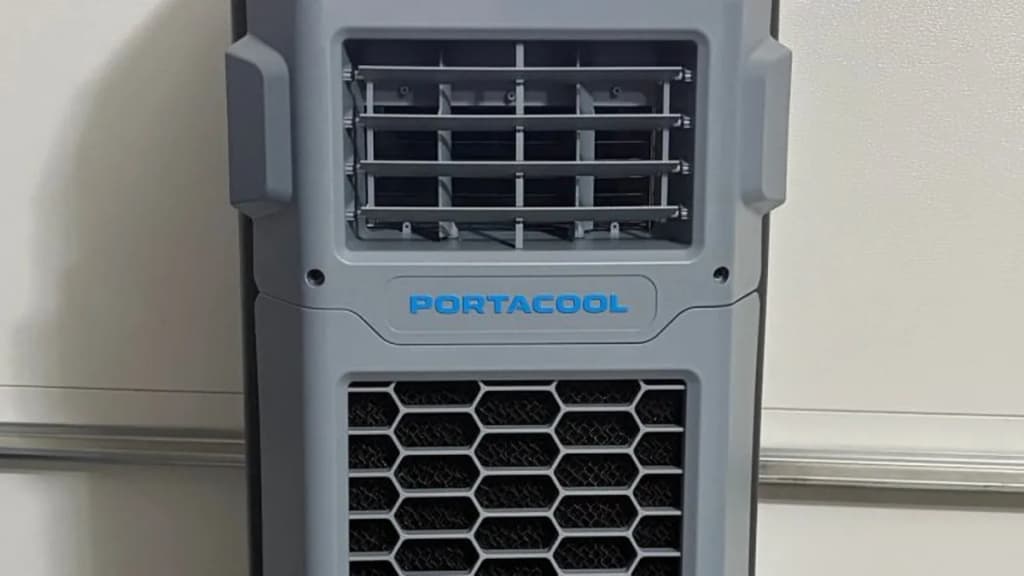
An evaporative air cooler, often referred to as a swamp cooler, is a cooling device that uses the process of water evaporation to lower the temperature of air in a specific space. Unlike traditional air conditioners, which utilize chemical refrigerants and compressors, evaporative coolers consume significantly less electricity by relying on the thermodynamic principle of evaporative cooling—where heat is absorbed as water transitions from liquid to gas.
At Groundwork, our analysis shows that the Portacool Apex 500 represents a high-end segment of this market, prioritizing material durability and digital integration over the budget-conscious design of entry-level units. With an 800 cubic feet per minute (CFM) airflow rating and a 13-gallon reservoir, this unit is engineered for spaces up to 500 square feet, particularly in arid climates where low humidity maximizes the cooling effect.
The Portacool Apex 500 functions by pulling warm ambient air through internal pads saturated with water. As the air passes through these moisture-laden media, water evaporates, absorbing heat energy from the air stream and resulting in a cooler discharge. According to thermodynamics research, this process is most effective when the relative humidity is low (typically below 40%), as dry air has a greater capacity to absorb moisture than humid air.
The Apex 500 utilizes "EdgeCoat"-treated cooling pads. These pads are designed to increase the surface area available for water-to-air contact, which improves the evaporation rate compared to standard, untreated cellulose pads. By maximizing this surface area, the unit achieves a more consistent temperature drop across the airflow stream. At Groundwork, we emphasize that the efficiency of this system is directly tethered to your local climate; in high-humidity environments, the evaporation rate slows, which significantly diminishes the unit’s cooling capacity.
The Portacool Apex 500 features a roto-molded housing, which is a manufacturing process that creates a seamless, durable plastic shell. Unlike injection-molded plastics, which can be prone to cracking under thermal stress or physical impact, roto-molded polyethylene offers high impact resistance and structural integrity. This is a critical factor for equipment often used in garages, workshops, or semi-outdoor settings.
When evaluating the total cost of ownership, the premium price of the Apex 500 is offset by its longevity and serviceability. The unit includes a 13-gallon tank, which reduces the frequency of manual refills. Furthermore, it supports a direct hose connection, allowing for continuous operation without the need for manual water management. For users operating in high-heat environments, the automatic pump shut-off feature serves as a vital safeguard, preventing the motor from burning out if the water supply is exhausted.
Keep exploring
More from GroundworkThe integration of Wi-Fi connectivity and a dedicated mobile application distinguishes the Apex 500 from the majority of commercial evaporative coolers. In our assessment, these features are not merely aesthetic; they provide actionable data that improves operational efficiency. The digital water level indicator alerts users to low-water states, while the app allows for remote monitoring of temperature and performance settings.
This level of oversight is particularly valuable for those cooling non-living spaces like garages or workshops. Instead of manually checking the unit, the app provides real-time status updates, allowing users to adjust the fan speed or oscillation modes remotely. The motorized oscillating louvers further enhance performance by distributing the cooled air stream across a wider area, preventing the "hot spots" that often occur with static-direction cooling fans.
In field tests conducted in temperatures reaching the mid-90s Fahrenheit, the Apex 500 demonstrated the ability to maintain internal temperatures near 70 degrees Fahrenheit, provided the environment remained dry. This represents a cooling delta of approximately 20 degrees, which is consistent with high-performance evaporative cooling benchmarks.
However, users must account for the 800 CFM airflow rating. While sufficient for 500 square feet, the effectiveness of the cooling is limited by the volume of air exchange. To maximize performance, we recommend the following:
- Ensure adequate ventilation: Evaporative coolers require a constant supply of fresh air to operate effectively. Keep a window or door slightly open to prevent the room from becoming humid, which will cause the cooling effect to stall.
- Maintain cooling pads: Periodically inspect the EdgeCoat pads for mineral buildup. In areas with hard water, calcium deposits can clog the pad fibers, reducing evaporation efficiency.
- Position strategically: Place the unit in a position where the intake has clear access to the warmest air in the room, and the exhaust can blow across the primary activity area.
- Utilize the timer/app: Program the unit to pre-cool the space before you occupy it to capitalize on the thermal mass of the room.
The decision to invest in the Apex 500 should be based on your specific environmental conditions and the intended use case. If you live in a low-humidity region and require a durable, mobile solution for a workshop or large garage, the technical specifications of the Apex 500 provide a clear advantage over budget-tier alternatives.
Conversely, if you live in a humid climate, an evaporative cooler will provide little to no benefit, as the air is already saturated with moisture. In such cases, a portable refrigerated air conditioner would be the more effective, albeit more energy-intensive, choice. At Groundwork, we recommend verifying your local average relative humidity during peak summer months before committing to an evaporative cooling solution.