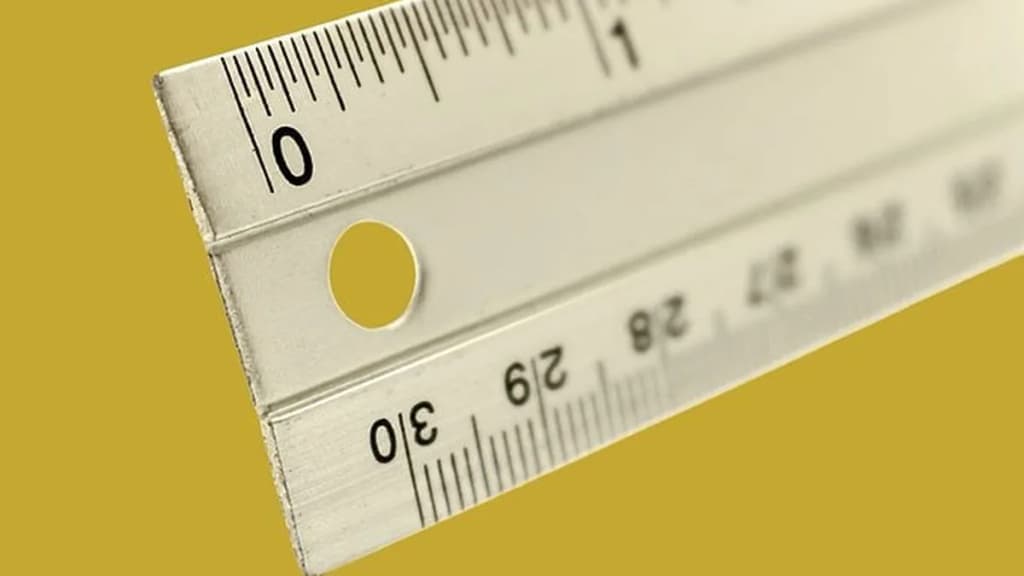
A ruler is a precision measuring instrument designed to quantify the distance between two points, and its accuracy depends entirely on your ability to align the zero mark with the start of your measurement. While many household rulers feature a gap between the physical end of the tool and the zero graduation, this is a deliberate engineering design choice rather than a manufacturing defect. At Groundwork, our analysis shows that confusion regarding this gap is a leading cause of systematic error in DIY home projects, often leading to misaligned cuts or improper material sizing.
The gap between the physical end of a ruler and the zero graduation line serves to protect the integrity of the measurement scale from physical degradation. According to research from the L.S. Starrett Company, a primary manufacturer of precision measuring tools, the edges of rulers are the most susceptible areas to impact, chipping, and wear. By recessing the zero mark, manufacturers ensure that even if the physical tip of the ruler is damaged, the calibrated scale remains accurate and reliable for the life of the tool.
Furthermore, the gap provides a margin for manufacturing tolerances. When rulers are molded or cut during production, the very edge of the material may be subject to minor inconsistencies. By moving the zero mark inward, manufacturers isolate the scale from these edge variations. This design ensures that every unit of measurement—whether inches or centimeters—maintains its intended distance from the origin point. Without this buffer, a chipped wooden ruler or a dented metal edge could shift your zero point by a significant fraction of an inch, rendering subsequent measurements invalid.
The most common error in manual measurement occurs when an individual assumes the physical end of the ruler represents the zero point. If your ruler has a gap and you align the edge of the object with the edge of the ruler, you are effectively adding an arbitrary offset to your measurement. This lead-in error—often ranging from 1 to 5 millimeters depending on the tool—can result in cumulative errors when marking multiple points on a workpiece.
At Groundwork, our research into measurement systems highlights that consistency is the foundation of precision. When you treat the edge of the ruler as the starting point instead of the zero line, you introduce a systematic bias into your process. In carpentry and home improvement, this bias is often the difference between a seamless joint and a gap-filled finish. To maintain accuracy, you must treat the ruler as a relative measurement device where the zero line is the only absolute reference point.
To ensure your measurements are precise, follow these steps every time you use a ruler, regardless of whether it has a gap or an edge-to-edge scale:
Keep exploring
More from Groundwork
- Inspect the ruler: Look closely at the zero graduation. Determine if it aligns perfectly with the physical end of the tool or if there is a gap. If a gap exists, ignore the edge of the ruler entirely.
- Establish the origin: Place the zero graduation line directly over the starting point of the object you are measuring. Do not place the object against the physical end of the ruler.
- Secure the alignment: Hold the ruler firmly against the surface. If you are marking a line, use a sharp mechanical pencil or a marking knife rather than a thick-tipped marker to minimize the width of your mark, which can introduce further error.
- Read at eye level: To avoid parallax error—an optical phenomenon where the perceived position of an object shifts due to the observer's viewing angle—ensure your eyes are directly above the graduation mark you are reading.
- Verify the end point: Identify the graduation mark that aligns with the far edge of your object. If it falls between two marks, determine the smallest subdivision on your ruler (e.g., 1/16th of an inch) and estimate the distance accordingly.
Edge-to-edge rulers, often found in precision machinist tools or specialized drafting equipment, provide an alternative approach to measurement. These tools are designed so that the zero graduation is positioned exactly at the physical boundary of the rule. Stanford’s DREME Teaching Resources notes that while these rulers can simplify the initial placement for some users, they are arguably more fragile. Because the zero point is at the very edge, any damage to that edge renders the tool inaccurate for its intended purpose.
Choosing between a recessed-zero ruler and an edge-to-edge ruler depends on your specific application. For general home maintenance and DIY projects, a recessed-zero ruler is often more durable and practical. The gap acts as a protective "bumper" that preserves the utility of the tool over years of use in a workshop environment. Conversely, if you are performing high-precision layout work where you need to measure from an inside corner, an edge-to-edge ruler or a specialized hook-end tape measure may be necessary to ensure the zero point is correctly positioned at the corner.
Even with a high-quality ruler, human error and tool limitations create a level of measurement uncertainty. The goal of using a proper technique is to minimize this uncertainty. When you are working on a project that requires tight tolerances, such as building cabinetry or installing trim, avoid "rounding" your measurements. If your ruler shows a measurement is between two 1/16th inch marks, record the value as precisely as your eye can discern.
At Groundwork, we emphasize that the primary goal of any measurement process is repeatability. By consistently using the zero line as your reference point and ignoring the physical edges of the ruler, you eliminate one of the most common variables in manual measurement error. This disciplined approach ensures that your marks are consistent, your cuts are accurate, and your project results align with your initial design plans.