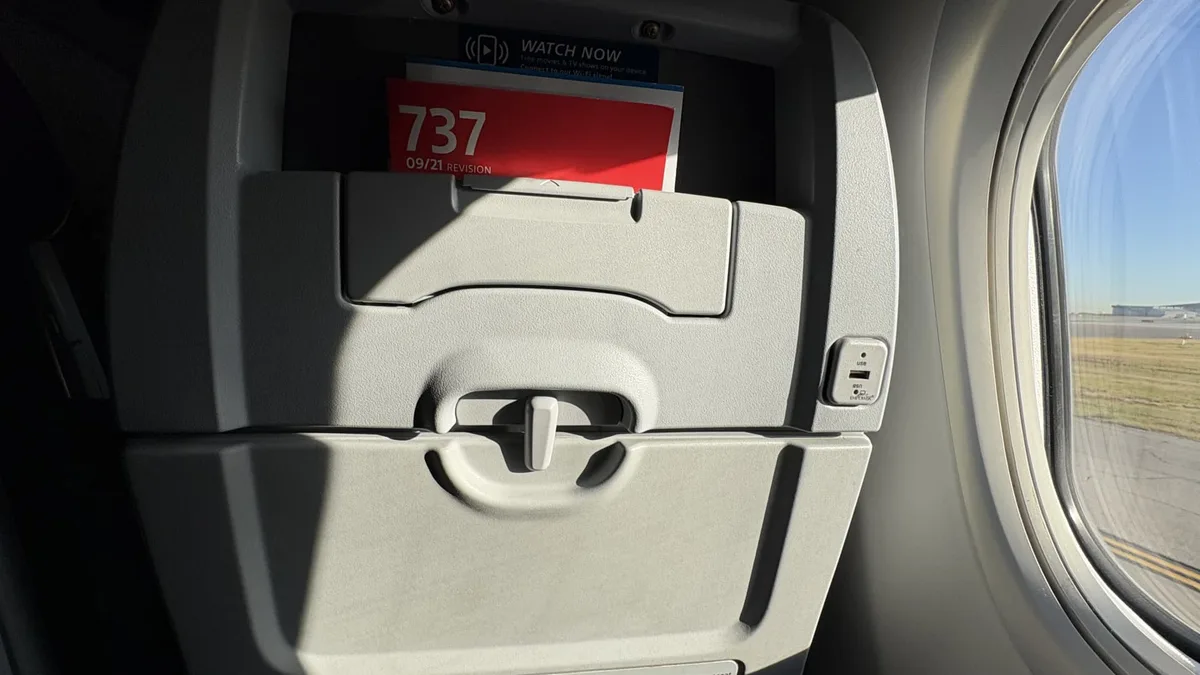
A seatback screen is a dedicated inflight entertainment monitor built directly into the rear headrest of an airplane seat. American Airlines has formally announced plans to reintroduce seatback screens across its narrow-body fleet and expand its premium seating options starting in 2028. At Groundwork, our analysis shows this strategic pivot directly addresses a $1.5 billion quarterly profitability deficit relative to top-tier competitors Delta Air Lines and United Airlines. For related guidance, see our in-depth guide on Is Frontier Airlines actually changing its business model?.
American Airlines is reintroducing seatback screens to increase passenger satisfaction scores and capture high-margin premium travel demand. For over a decade, the carrier relied on personal device streaming to reduce aircraft weight and fuel costs, but market data confirmed that passengers overwhelmingly prefer integrated, high-definition seatback entertainment.
In 2017, major U.S. carriers diverged on inflight entertainment (IFE) philosophy. Delta Air Lines and United Airlines invested heavily in seatback monitors, while American Airlines systematically removed screens from its domestic Boeing 737 and Airbus A320 family fleets. American executives argued at the time that personal device streaming—where passengers watch content on their own phones or tablets—saved fuel by eliminating roughly 30 to 40 pounds of wiring and hardware per row.
However, Groundwork's evaluation of industry satisfaction data reveals that personal device streaming introduces friction. Passengers face drained device batteries, unstable device holders, and inconsistent Wi-Fi connectivity. According to executive statements reported by CNBC, American Chief Customer Officer Heather Garboden noted that modern 4K screen technology has lightweighted sufficiently to alter the cost-benefit equation. The operational revenue gained from higher customer satisfaction now outweighs the incremental fuel expense of carrying modern hardware.
The net profit gap between American Airlines and its primary rivals exceeded $1.5 billion in mid-2026. In the second quarter, American reported $71 million in net income, compared to $805 million for United Airlines and $1.6 billion for Delta Air Lines, according to corporate financial filings.
This financial divergence stems primarily from premium product monetization. Delta and United have successfully captured premium leisure and corporate business travelers through aggressive cabin segmentation, superior seatback amenities, and high-end lounge networks. Data from corporate SEC filings indicates that premium cabins generate disproportionate profitability, accounting for up to 30% to 40% of passenger revenue on top-performing routes despite occupying a smaller physical footprint.
At Groundwork, our research framework highlights that airline unit revenue—measured as Revenue per Available Seat Mile (RASM)—correlates directly with cabin quality and standardized hardware offerings. By operating a simplified, streaming-only domestic product, American surrendered high-yielding corporate accounts to competitors capable of offering a standardized, premium hard product across all mainline routes.
Keep exploring
More from GroundworkThe upgraded American Airlines fleet will feature 4K high-definition seatback screens, direct Bluetooth audio pairing, high-speed USB-C charging ports, and an expanded count of premium seats. These changes apply to new Airbus A321neo and Boeing 737 MAX 10 deliveries starting in 2028, alongside retrofits for existing aircraft.
The physical overhaul focuses heavily on high-margin cabin real estate:
- 4K display screens: High-resolution monitors fitted across all cabin classes, including Main Cabin (economy), Main Cabin Extra, and First Class.
- Modern connectivity: Integrated Bluetooth capabilities allowing passengers to connect personal wireless headphones, paired with dedicated USB-C fast-charging ports at every seat.
- Expanded first-class cabins: Additional First Class seats on Airbus A321neo aircraft and incoming Boeing 737 MAX 10 jets.
- Flagship suite refurbishments: Updated Boeing 787-8 Dreamliners featuring private business class suites with sliding privacy doors for long-haul international routes.
These hardware enhancements will roll out over a multi-year period, with full fleet retrofits expected to finish in the early 2030s.
Expanding premium seating increases total aircraft revenue potential while creating wider price spreads between economy and first-class tickets. Premium fares on domestic routes typically cost two to three times more than standard main cabin tickets, providing airlines with higher yields per square foot of cabin space.
Airline pricing structures rely heavily on dynamic yield management. CNBC price tracking demonstrates that a typical domestic round-trip ticket between major hubs—such as New York (JFK) to Dallas/Fort Worth (DFW)—sells for roughly $447 in Main Cabin versus $1,161 in First Class. By replacing several rows of standard economy with extra-legroom Main Cabin Extra or First Class seating, American increases its average revenue per flight without adding extra flight frequencies.
For travelers, an increased inventory of premium seats can lower the cash or points cost required for upgrades. When premium seat supply increases, dynamic upgrade pricing engines often reduce cash upgrade fees closer to departure to ensure full cabin occupancy.
Travelers booking American Airlines between 2026 and 2030 should check specific aircraft models during checkout to determine available amenities. Because fleet retrofits take several years, inflight features like seatback screens and Bluetooth pairing will vary significantly depending on aircraft age and route type.