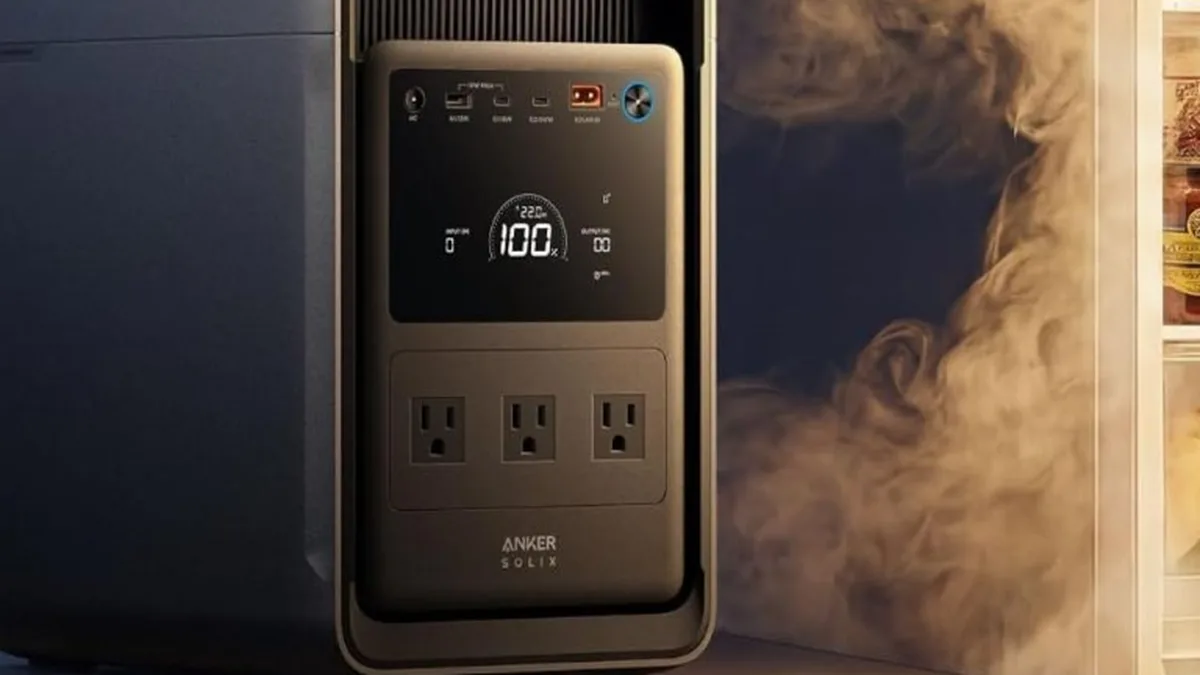
A portable power station is a rechargeable, battery-powered inverter generator designed to supply electricity to household appliances and electronic devices during grid outages. Unlike conventional gas generators, these solid-state battery systems operate silently, emit no carbon monoxide, and can be safely used inside living spaces. For related guidance, see our in-depth guide on Anker solix s2000 portable power station: performance and value analysis.
Ahead of storm season, major power station manufacturers frequently discount equipment by 20% to 46%. At Groundwork, our analysis shows that evaluating these seasonal promotions requires looking past broad percentage discounts and analyzing fundamental engineering metrics: cost per watt-hour ($/Wh), inverter surge capacity, continuous wattage, and battery cell chemistry. Understanding these specifications ensures you select a power station capable of sustaining essential medical, refrigeration, and communication loads without paying for unneeded capacity.
You need a minimum battery capacity of 1,000 watt-hours (Wh) to run essential electronics and small appliances for 24 hours, or 2,000Wh to power a full-sized household refrigerator alongside medical devices and lighting. Calculate capacity by multiplying total appliance wattage by your desired runtime hours and adding a 15% efficiency buffer.
Determining capacity starts with separating continuous running watts from peak startup surge watts. Essential household loads generally fall into predictable electrical draw bands:
- Full-sized refrigerator (18–22 cu. ft.): 100–200 continuous running watts; 800–1,200 peak surge watts (compressor start).
- CPAP machine (without heated humidifier): 30–60 continuous running watts.
- Wi-Fi router and modem: 10–25 continuous running watts.
- LED lighting (per room): 10–30 continuous running watts.
- Smartphones and tablets: 10–15 watt-hours per full charge.
Because refrigerators cycle their compressors on and off roughly 33% to 50% of the time, a 150W refrigerator consumes roughly 50W per hour on average (1,200Wh per 24-hour period). Modern pure sine wave inverters operate at approximately 85% to 90% efficiency due to internal DC-to-AC conversion losses, as documented in power inverter benchmarks from the U.S. Department of Energy (DOE). Consequently, powering a 1,200Wh daily refrigerator load requires a power station with an actual rated capacity of at least 1,400Wh to avoid total discharge.
Calculate true value by dividing the retail price of the system by its rated battery capacity in watt-hours ($/Wh). A price-per-watt-hour at or below $0.35/Wh represents an exceptional entry point for modern lithium iron phosphate (LiFePO4) systems, whereas baseline retail prices typically range between $0.60 and $0.90/Wh.
Seasonal promotional events offer substantial shifts in unit economics across major industry brands. Evaluating price cuts using the $/Wh benchmark reveals clear tier divisions:
Units in this tier serve as primary emergency power hubs for extended grid failures. The Anker SOLIX S2000, discounted to $649.99 from $1,199 for a 2,010Wh rating, reaches a unit cost of $0.32/Wh. According to Groundwork research benchmarks, reaching the sub-$0.35/Wh threshold for a primary 2kW power station represents one of the lowest price points per storage unit available in the consumer battery market.
This class provides the baseline energy required to keep critical food cold and essential medical equipment powered for 12 to 24 hours. The EcoFlow Delta 3 Classic at $499 (1,024Wh capacity) delivers a rate of $0.48/Wh. Similarly, the Jackery Explorer 1000 v2 at $499 provides $0.49/Wh. While higher than 2kWh pricing, sub-$0.50/Wh rates for 1kWh units represent strong baseline value for entry-level home emergency preparations.
Keep exploring
More from GroundworkWhen purchasing solar bundles, subtract the fair market value of the solar panel (typically $1.00 to $1.50 per nominal solar watt) before calculating battery value. For example, a $699 bundle containing a 1,070Wh power station and a 200W solar panel includes roughly $200 of solar hardware value, reducing the effective power station cost to $499 ($0.46/Wh).
Battery chemistry dictates the overall operational lifespan, thermal safety, and long-term cost of ownership of a portable power station. Lithium Iron Phosphate (LiFePO4 or LFP) batteries offer 3,000 to 4,000 charge cycles to 80% capacity, compared to 500 to 800 cycles for traditional Nickel Cobalt Manganese (NCM) lithium-ion cells.
While older NCM power stations are lighter and slightly more compact, LiFePO4 cells have quickly become the industry standard for home backup for two structural reasons:
- Cycle longevity: A LiFePO4 battery rated for 3,000 cycles can be fully discharged and recharged daily for over eight years before losing 20% of its original capacity. Under typical emergency storage and testing schedules (20 cycles per year), a LiFePO4 power station maintains functional performance for 10 to 15 years.
- Thermal and chemical stability: Research published by the National Renewable Energy Laboratory (NREL) demonstrates that LiFePO4 chemistry exhibits significantly higher thermal runaway thresholds (~270°C) compared to NCM chemistry (~210°C). This stability makes LFP units far safer to store at high states of charge inside homes and garages during warm storm seasons.
When assessing discounted hardware, confirm that the system utilizes LiFePO4 cells. Steeper discounts on older models often indicate inventory clearing of short-lifespan NCM inventory.
Size solar panels by matching the maximum solar input rating (in watts) of your power station while accounting for an average 25% to 30% environmental energy loss factor. To fully recharge a 1,000Wh power station within 6 peak sunlight hours, you require at least 200W of real-world solar panel output.
Power stations rely on integrated Maximum Power Point Tracking (MPPT) charge controllers to extract solar energy. Standard solar panels lose efficiency due to cloud cover, non-optimal tilt angles, ambient heat, and atmospheric haze. Groundwork testing frameworks establish that a solar panel array yields approximately 70% to 75% of its nameplate wattage during typical operational conditions.
To calculate required solar capacity during a prolonged grid outage:
$$\text{Required Solar Nominal Watts} = \frac{\text{Battery Capacity (Wh)}}{\text{Peak Sun Hours} \times 0.75}$$