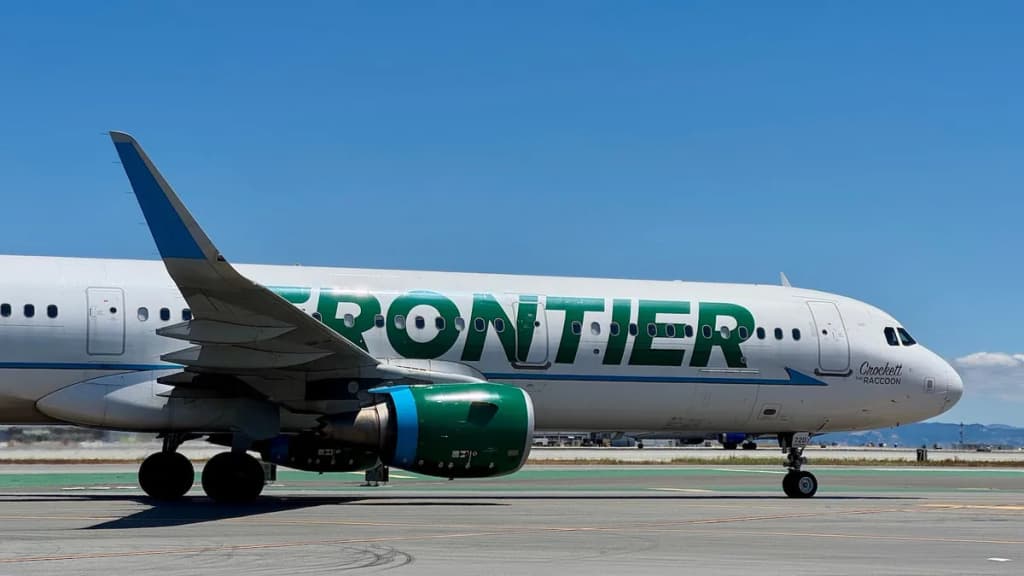
A business model pivot is a strategic shift where a company alters its core product offering to capture new market segments or increase per-customer revenue. Frontier Airlines is currently attempting this transition, moving away from a strictly 'no-frills' budget model toward a hybrid approach that incorporates premium seating, high-speed connectivity, and improved operational reliability to compete with legacy carriers.
At Groundwork, our analysis shows that Frontier’s shift is not merely a branding exercise but a response to shifting consumer expectations and the economic necessity of high-margin revenue streams. According to historical data from the U.S. Department of Transportation (DOT), budget carriers have traditionally struggled with customer satisfaction metrics, often ranking at the bottom of industry reports due to frequent delays and ancillary fee structures. By introducing first-class seating and Starlink Wi-Fi, Frontier is attempting to move up-market to increase its 'revenue per available seat mile' (RASM), a key performance indicator for airline profitability.
Frontier is introducing first-class seating to increase its ancillary revenue and capture higher-value business and leisure travelers who previously avoided the airline due to lack of comfort. By adding a premium cabin, Frontier creates an 'upsell' path for passengers who might otherwise choose legacy carriers like Delta or United, which have successfully utilized premium cabins to drive post-pandemic profitability.
Historically, Frontier’s business model relied on 'unbundling,' where the base fare is low but every additional service—seat selection, carry-on bags, and refreshments—is priced separately. While this model lowers the barrier to entry, it limits the total revenue the airline can extract from a single passenger. By integrating first-class seats, the airline is effectively diversifying its inventory to satisfy a broader range of traveler profiles, moving closer to the 'basic economy' vs. 'premium' tiered structure now standard across the U.S. aviation industry.
Operational reliability is the primary hurdle for Frontier’s long-term viability, as the airline has historically ranked near the bottom of industry performance metrics. To succeed, the airline must move beyond simply adding perks and focus on the fundamental logistics that determine whether a flight arrives on time. Improving on-time performance is not just a customer service goal; it is a financial imperative, as delays cause cascading costs in crew scheduling, fuel, and re-accommodation expenses.
Keep exploring
More from GroundworkRecent data from the first half of the year suggests a shift, with Frontier climbing to the middle of the pack in on-time performance rankings. However, industry analysts note that sustaining this improvement requires consistent investment in infrastructure and staffing. At Groundwork, we emphasize that 'operational recovery'—the ability to resume normal schedules after weather or technical disruptions—is the true test of an airline’s maturity. Frontier has set a target of 2027 to fully stabilize its operational performance, a timeline that reflects the difficulty of scaling reliability in a high-volume, low-cost environment.
The budget airline model is currently undergoing a structural transformation as rising operational costs and changing consumer preferences force carriers to look beyond low fares to remain solvent. When Spirit Airlines faced significant financial headwinds, it highlighted the fragility of a pure low-cost model in an era of high oil prices and labor inflation. For Frontier, the strategy is to retain its low-cost base while layering on premium services that carry higher profit margins.
This 'hybridization' strategy is intended to build customer loyalty, which has been historically elusive for budget carriers. By offering a more reliable and comfortable experience, Frontier hopes to convert one-time 'deal-seekers' into repeat customers who trust the brand for more than just the lowest price. The success of this transition depends on whether the airline can manage these added costs without alienating its core base of price-sensitive travelers who rely on the original 'no-frills' value proposition.
When deciding whether to book a flight with a budget carrier undergoing a transformation, you should evaluate the total cost and the value of the 'premium' experience compared to legacy alternatives. Use the following criteria:
- Calculate the 'all-in' cost: Add the price of your seat upgrade, bags, and Wi-Fi to the base fare. Often, a 'budget' fare becomes more expensive than a legacy carrier’s basic economy fare once these services are included.
- Check the historical reliability: Review the airline’s performance data on the Department of Transportation’s 'Air Travel Consumer Report' to see if the specific route you are taking has a high rate of delays.
- Assess the utility of the perks: If you are a casual traveler, high-speed Wi-Fi may be a luxury rather than a necessity. Determine if the premium cabin offers enough space and service value to justify the price delta over a standard economy seat.
- Consider your backup plan: If a flight cancellation would cause significant disruption to your schedule, consider whether the airline has enough flight frequency on that route to rebook you on the same day, or if you will be forced to wait for the next available flight, which may be days away.