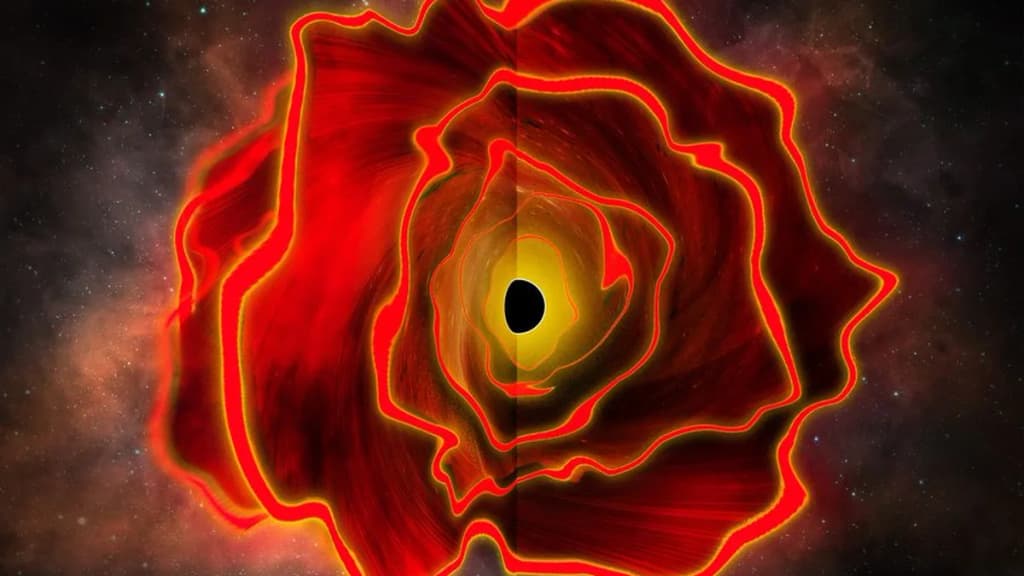
A black hole star is a theoretical cosmic object consisting of a supermassive black hole at its core, surrounded by an exceptionally dense, luminous envelope of gas and dust. While they resemble distant stars in terms of brightness and color, their energy output far exceeds the physical limits of nuclear fusion, suggesting a more complex internal structure.
Recent data from the James Webb Space Telescope (JWST) has provided the first compelling evidence for these objects, specifically through the observation of a phenomenon designated MoM-BH*-1. According to research published in Nature, this object dates back to when the universe was approximately 660 million years old (Nature, 2024). While it appears as a reddish, star-like point in deep-space imagery, its behavior defies standard stellar classification.
A regular star generates energy through nuclear fusion within its core, converting hydrogen into helium. In contrast, a black hole star derives its luminosity from the gravitational energy of matter being consumed by a central black hole. This process, known as accretion, releases radiation that is orders of magnitude more powerful than the fusion processes found in even the largest known stars.
The object MoM-BH*-1, for instance, emits roughly 100 billion times more energy than the theoretical upper limit for standard stellar fusion (Wired, 2024). Because this energy must pass through a massive, dense cloud of surrounding gas before reaching our telescopes, the light spectrum is altered. This creates an observational signature that mimics starlight, leading early researchers to misidentify these systems as simple, giant stars in the early universe.
The discovery of MoM-BH*-1 helps bridge a critical gap in our understanding of the early universe. Astronomers have long struggled to explain why the JWST repeatedly identifies compact, bright red objects that do not fit into existing categories of stars or galaxies. If these objects are indeed black hole stars, it suggests that black holes were far more active and influential in the formation of the early cosmos than previously assumed.
This hypothesis provides a potential solution to the "missing mass" problem in early galactic evolution. If massive black holes were surrounded by such dense gas envelopes shortly after the Big Bang, they would have served as the primary drivers of luminosity, effectively masking their true nature. This challenges the current consensus that galaxies grew exclusively through the gradual accumulation of stars and suggests that black holes were fundamental "seeds" that shaped the architecture of the universe from its infancy.
Keep exploring
More from GroundworkAstronomers identify black hole stars by analyzing the specific wavelengths of light emitted by distant, high-energy objects. While a standard star shows a predictable spectrum of light, MoM-BH*-1 exhibits an abrupt disappearance of certain light frequencies that cannot be explained by standard stellar atmospheric absorption. Researchers attribute this to the intense density of the gas surrounding the black hole, which absorbs light in a way that suggests a much more violent, compact source than a fusion-powered star.
To confirm these observations, scientists use the following criteria:
- Spectral Analysis: Checking if the light emission signature exceeds the Eddington limit—the maximum luminosity a star can reach before its own radiation pressure blows it apart.
- Temporal Consistency: Monitoring the object for light fluctuations that correlate with the chaotic, high-energy accretion of matter onto a black hole rather than the steady state of nuclear fusion.
- Comparative Modeling: Comparing the observed red-shift and brightness against simulated models of black holes shrouded in gas to see if the data points align.
The identification of black hole stars forces a re-evaluation of how we interpret data from the James Webb Space Telescope. If a significant percentage of the "stars" we see in the early universe are actually black holes, our estimates of the number of stars and the rate of galaxy formation during the first billion years of the universe may be fundamentally flawed.
Moving forward, researchers are looking to:
- Refine Deep-Field Observations: Using longer exposure times to capture the subtle variations in light that distinguish black hole accretion from stellar fusion.
- Develop New Theoretical Models: Creating simulations that account for the interaction between black hole gravity and surrounding gas envelopes in high-density environments.
- Cross-Reference Data: Correlating JWST infrared data with other observatories to determine if these objects emit X-ray signatures, which would be a "smoking gun" for the presence of an active black hole.
This shift in perspective does not invalidate previous work, but it adds a layer of complexity to the cosmic timeline. As we continue to look deeper into space, we are effectively looking further back in time, and the existence of these "disguised" black holes means the early universe was likely a much more dynamic and high-energy environment than standard stellar evolution models predicted.