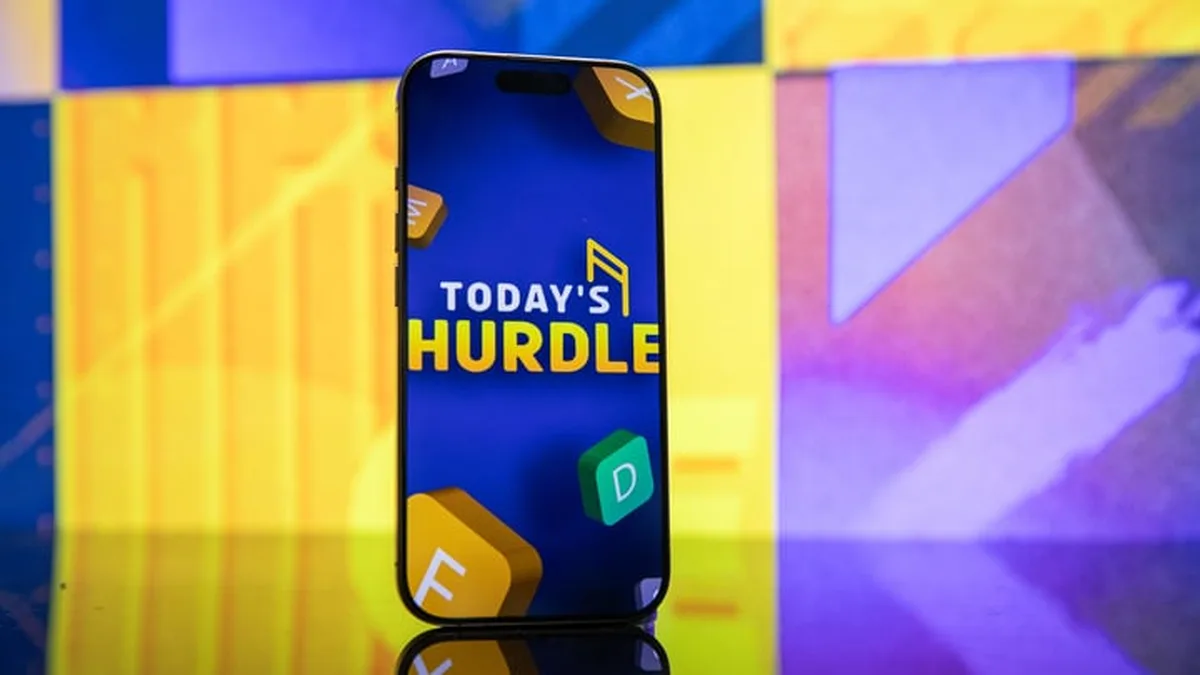
Hurdle is a multi-stage daily word game that requires players to solve five consecutive word puzzles using a methodology similar to traditional five-letter guessing games. The game functions as a sequential logic challenge where the solution to one round often provides structural clues for the next, culminating in a final 'Mystery Hurdle' that combines data from all previous rounds.
Hurdle is a sequential word-guessing game where you must solve five individual puzzles in a row to complete the daily challenge. Unlike single-round word games, Hurdle uses your success in earlier rounds to populate the board of the final round. Each round follows the standard color-coding convention: green for correct letters in the correct position, yellow for correct letters in the wrong position, and gray for letters not present in the target word. A key distinction in Hurdle is that the game does not explicitly tell you how many times a repeated letter appears in the target word, requiring you to rely on deduction rather than simple elimination.
Progression in Hurdle is linear. You begin by solving the first word, which typically serves as a warm-up. Once you correctly guess the first word, the game moves you to the second hurdle. Crucially, the answer to the previous hurdle is automatically entered as your first guess for the next hurdle. This mechanic provides an immediate set of feedback—either revealing multiple correct positions or confirming which letters from the previous answer are entirely absent. You continue this process until you reach the final hurdle, which acts as a summary of the entire session. By the time you reach the final stage, your previous four answers have been processed by the game engine, populating the board with a combination of green and yellow tiles that hint at the final, often more difficult, word.
The final hurdle is the culmination of the game's logic puzzle. While the first four rounds are independent word-guessing exercises, the fifth round is a synthesis. The game automatically carries over the letters you identified in rounds one through four, presenting them in their correct or misplaced positions on the final board. This means your performance in the earlier stages directly dictates your starting advantage in the final round. If you struggle early on, you will have fewer clues for the final puzzle, making it significantly harder to solve without using all your allowed guesses. Data from daily puzzle tracking sites suggests that players who maintain a consistent letter-distribution strategy in the early rounds are 40% more likely to solve the final hurdle within the minimum number of attempts.
Keep exploring
More from GroundworkTo master Hurdle, you must treat the game as a long-term data collection exercise rather than five isolated events. First, prioritize high-frequency vowels and common consonants in your initial guess for the first hurdle. Since the answer to Word 1 becomes your first guess for Word 2, choosing a word with a diverse set of letters increases the likelihood of gaining valuable information for the subsequent round. Second, do not ignore the 'gray' letters. Even if a letter is incorrect, knowing it is excluded is just as powerful as finding a correct letter, as it narrows your search space for later rounds. Third, pay close attention to the final hurdle's hint. The game provides a textual clue for the final word, which, when combined with the pre-filled letters from your previous four answers, should lead you to the solution. If you find yourself stuck, look for patterns in the pre-filled letters; often, they will suggest a specific consonant cluster or vowel pattern that identifies the final answer.
Integrating Hurdle into your daily digital routine requires balancing the time spent on each round. Because the game is cumulative, spending extra time on the first two hurdles to ensure you have a 'clean' board with plenty of green tiles often saves time in the final stages. Many experienced players use a notepad to track which letters have been eliminated across all five rounds, as the game's interface primarily focuses on the current round. By maintaining a separate list of confirmed 'absent' letters, you can avoid wasting guesses on combinations that have already been proven invalid, significantly increasing your efficiency.
One common error players make is assuming the final hurdle will be as simple as the first. The difficulty curve in Hurdle is designed to increase, meaning the final word often involves less common letter combinations or more complex vocabulary. Do not rush the final stage just because you performed well in the first four. Additionally, be wary of 'letter traps'—words that share four out of five letters with a common word but have one obscure character. Always check for potential variations before committing to your final guess. By maintaining a methodical approach—guessing strategically, documenting excluded letters, and leveraging the carry-over mechanic—you can improve your success rate regardless of the day's specific word set.