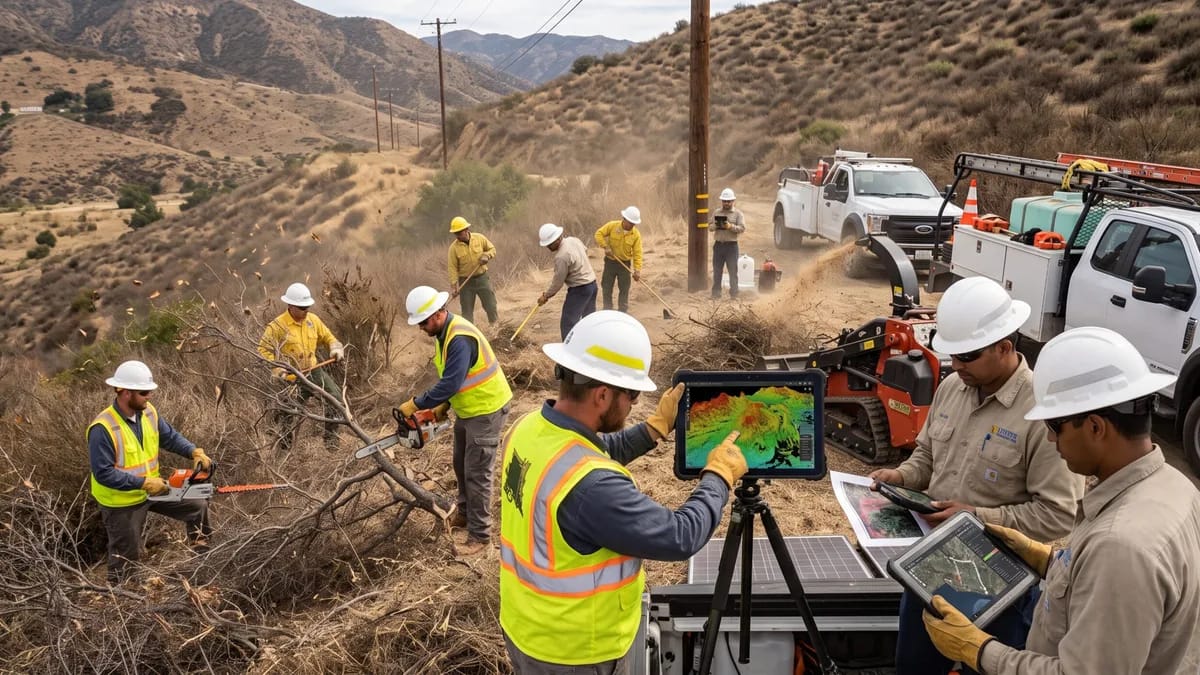
Wildfire mitigation is the systematic process of identifying, analyzing, and reducing the risk of power grid infrastructure sparking or being damaged by wildfires. As climate patterns shift and extreme weather becomes more frequent, traditional grid management models—which often rely on historical data and siloed operational structures—are proving insufficient. At Groundwork, our analysis shows that building a resilient grid requires transitioning from reactive, committee-based responses toward a centralized, data-driven operating model that prioritizes continuous improvement.
Standard utility reliability metrics, specifically SAIDI (System Average Interruption Duration Index) and SAIFI (System Average Interruption Frequency Index), were designed to measure grid performance under predictable conditions. These metrics track how long and how often customers lose power, but they do not account for the catastrophic, non-linear threats posed by wildfires. When operating conditions become unpredictable due to extreme heat, prolonged drought, and high winds, these metrics fail to capture the potential for cascading failures across an interconnected grid.
Research indicates that relying solely on historical weather patterns to forecast risk is a flawed strategy in the current climate environment. Utilities must instead adopt a dynamic risk-modeling framework that integrates real-time environmental data with aging infrastructure assessments. This shift moves the focus from simple outage restoration to predictive risk management, where the goal is to prevent the ignition event entirely rather than just responding after the fact.
Utilities historically operate through departmental silos, where vegetation management, grid operations, and engineering teams work on independent timelines and objectives. This fragmentation prevents the organization from seeing a unified picture of wildfire risk. To achieve true resiliency, utilities must establish a centralized wildfire management organization (CWMO) that integrates these disparate functions under a single governance structure.
- Establish centralized governance: Create a dedicated wildfire management office that reports directly to executive leadership to ensure that risk mitigation is prioritized across all departments.
- Standardize data flows: Break down information barriers by implementing a unified data platform where vegetation management, sensor data, and infrastructure health metrics are visible to all stakeholders.
- Align cross-functional goals: Shift KPIs from department-specific targets to shared resilience outcomes, such as 'risk-reduction per dollar spent' or 'timely deployment of hardening measures in high-risk zones.'
- Implement continuous feedback loops: Use post-event analysis and near-miss reporting to update risk models in real-time, ensuring that lessons learned are immediately incorporated into the next planning cycle.
Keep exploring
More from GroundworkContinuous improvement in the context of utility wildfire mitigation relies on the 'Plan-Do-Check-Act' (PDCA) cycle applied to grid hardening. Because the environment is changing, the mitigation plan you developed last year may not be effective today.
At Groundwork, our research into organizational resilience suggests that utilities should view wildfire mitigation as a perpetual feedback loop. 'Plan' involves identifying high-risk corridors using satellite imagery and predictive AI. 'Do' involves executing hardening tactics, such as installing insulated conductors or undergrounding power lines in critical zones. 'Check' requires validating whether these interventions actually reduced ignition risk during high-wind events. 'Act' involves refining the strategy based on that validation. This iterative process ensures that capital investments are directed toward the interventions that deliver the highest reduction in potential wildfire impact.
Utilities face a 'convergence of threats' where aging infrastructure, increasing electrification, and extreme weather interact to multiply risk. An aging pole that might have been safe in a moderate climate is a critical failure point under extreme wind loads.
To manage this, utilities must adopt a risk-based investment strategy that moves away from 'age-based' replacement cycles. Instead, prioritize infrastructure upgrades based on a combination of 'consequence of failure' and 'likelihood of ignition.' By overlaying wildfire hazard maps with grid asset data, utilities can identify 'high-consequence' segments where the potential for a wildfire is greatest. This methodology allows for the efficient allocation of limited resources, ensuring that the most vulnerable segments of the grid are addressed first.
Public and regulatory expectations have evolved significantly; stakeholders no longer accept 'unpredictability' as a defense for wildfire-related grid failures. Transparency in the decision-making process is now a fundamental requirement for utility operations.
Effective communication strategies must be integrated into the continuous improvement framework. By reporting on progress using clear, measurable metrics—such as the number of miles hardened or the reduction in 'ignition-prone' equipment—utilities can build trust with regulators and the communities they serve. Demonstrating that you are not just reacting to fires, but proactively managing risk through a rigorous, data-backed process, is essential for long-term operational and financial sustainability.