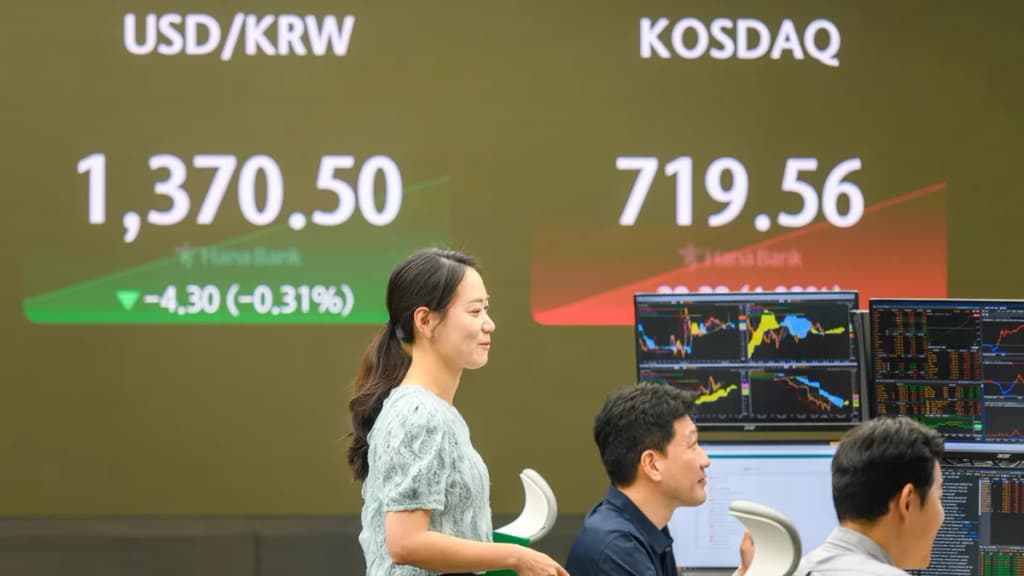
A shift in global retail investment behavior is currently unfolding as South Korean investors increasingly move capital from domestic equities into U.S.-listed securities. This trend is characterized by a preference for high-volatility assets, including leveraged exchange-traded funds (ETFs) and American Depositary Receipts (ADRs) of domestic firms, often at significant price premiums.
At Groundwork, our analysis shows that retail investors net bought $4.5 billion of U.S. stocks in July 2026, marking a notable departure from traditional home-market participation as domestic indices face corrections and increased volatility (Korea Securities Depository, 2026). This movement is not merely a geographic relocation of capital, but a strategic pivot toward aggressive, high-leverage instruments that mirror the risk profiles of the domestic sectors they are leaving behind.
South Korean investors are increasingly purchasing U.S.-listed ADRs of domestic companies, such as semiconductor manufacturer SK Hynix, even when those shares are available on the Korea Exchange. In July 2026, approximately $840 million was directed into these U.S.-listed receipts, which frequently trade at a premium compared to their Seoul-listed counterparts (Korea Securities Depository, 2026).
From a financial efficiency standpoint, this behavior is anomalous. Acadian Asset Management notes that these ADRs have recently traded at premiums near 10% over local shares, while simultaneously exhibiting higher realized volatility. Groundwork’s research framework suggests that paying a premium to own the same underlying asset creates an unnecessary drag on long-term returns. Investors who bypass local liquidity to pay higher prices in foreign markets are essentially paying a "speculation tax" for the perceived prestige or accessibility of U.S. exchange exposure. Such price dislocations are historically viewed by market analysts as indicators of speculative excess, reminiscent of regional market bubbles where investors prioritize momentum over fundamental valuation.
Leveraged ETFs have become a cornerstone of the current Korean retail portfolio strategy in U.S. markets. Data from the Korea Securities Depository indicates that in July 2026, four of the 10 most net-purchased U.S. securities were leveraged products. Among the most popular were the Direxion Daily Semiconductor Bull 3X Shares (SOXL) and the ProShares Ultra QQQ, both designed to multiply the daily performance of their underlying indices.
It is critical to understand that leveraged ETFs are designed for short-term tactical trading, not long-term wealth accumulation. Because these products reset their leverage daily, they are subject to "volatility decay"—a mathematical phenomenon where the path-dependent losses of a volatile market significantly erode the fund's value over time. When you hold a 3x leveraged fund for an extended period, the cumulative return will rarely equal three times the return of the underlying index. Groundwork’s analysis confirms that retail investors utilizing these products are essentially betting on short-term market momentum, which significantly increases the probability of total capital impairment during periods of high market turbulence.
Keep exploring
More from GroundworkWhile the geographic focus has shifted from Seoul to New York, the underlying investment theme remains largely unchanged. Many South Korean retail investors are exiting domestic semiconductor and AI-related stocks only to purchase U.S.-listed assets tied to the exact same industry themes. This creates a "geographic arbitrage" that fails to provide the diversification benefits usually associated with international investing.
True diversification requires exposure to assets with low correlation to one's existing portfolio. By selling a domestic chipmaker and buying a U.S.-listed leveraged semiconductor ETF, the investor has increased their sector concentration risk rather than mitigating it. Rayliant Global Advisors indicates that this behavior suggests investors are not seeking safety or stability, but are instead chasing the same "AI hardware" narrative that led to their domestic market losses. For the retail investor, this strategy effectively doubles down on sector-specific risk while adding the complexities of currency fluctuations and foreign transaction costs.
While the $4.5 billion inflow is significant from an individual retail perspective, it represents a small fraction of the broader U.S. equity market capitalization. However, concentrated retail buying in specific high-volatility, low-float instruments can create artificial price support or amplify volatility in individual stocks.
Groundwork’s synthesis of market data suggests that while these flows are unlikely to trigger a systemic shift in the U.S. markets, they can create localized "echo bubbles." When thousands of retail investors move in unison into the same leveraged products, they may create a feedback loop where buying pressure drives price action that is disconnected from the actual earnings or growth prospects of the underlying companies. As a retail investor, you should be wary of following "crowd sentiment" into these specific assets, as these positions are often the first to be liquidated when market sentiment shifts, leading to accelerated downward pressure and potential "stop-loss" cascades.
If you are considering moving capital into international markets, follow these evidence-based steps to avoid common pitfalls:
- Evaluate the cost of entry: Compare the total cost of ownership, including currency conversion fees, foreign tax withholding, and the premium paid for ADRs versus local shares.
- Assess your leverage exposure: If you are using leveraged ETFs, limit their use to short-term tactical hedging rather than long-term strategic allocation.
- Audit your correlation risk: Ensure that moving to a new market actually provides diversification. If you are selling a tech stock in one country to buy a tech ETF in another, you have not diversified your risk.