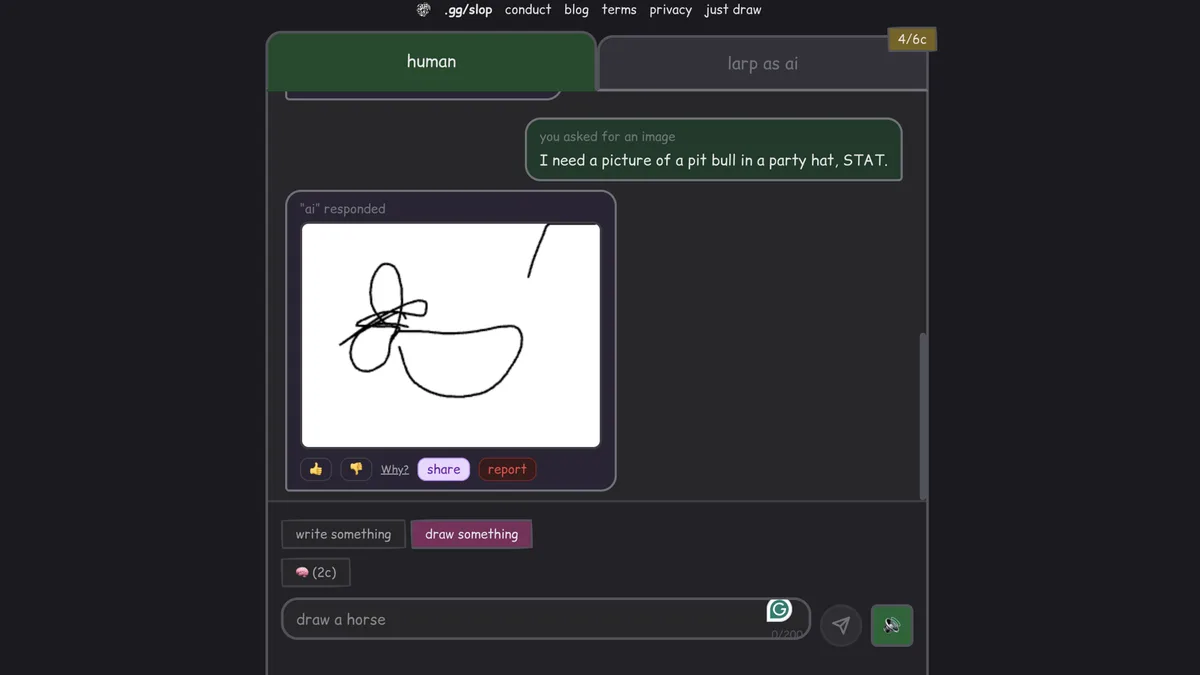
Roleplaying as an AI chatbot is the practice of mimicking the linguistic patterns, constraints, and operational logic of a Large Language Model (LLM) to understand how these systems process information. By stepping into the role of the machine, you gain a practical understanding of how artificial intelligence translates human prompts into structured, often predictable outputs, while highlighting the inherent limitations of current generative technology.
Recent platforms like 'Your AI Slop Bores Me' have gamified this interaction, requiring users to switch between the roles of the prompter and the machine. This binary experience demonstrates that much of what we perceive as 'intelligence' in AI is actually a feedback loop between human expectation and algorithmic pattern matching. When you act as the AI, you are forced to confront the mechanical nature of token prediction, rigid formatting, and the lack of genuine cognitive intent.
According to research from the Stanford Institute for Human-Centered AI, LLMs are effectively probabilistic engines that predict the next logical token in a sequence rather than 'understanding' context in a human sense (Stanford HAI, 2023). By forcing yourself to manually replicate this process, you bridge the gap between abstract tech jargon and the reality of how these tools function.
Roleplaying as an AI provides a direct, visceral lesson in prompt engineering by showing you exactly how ambiguous instructions lead to generic or 'slop' outputs. When you are the one responsible for generating an answer within a strict time limit, you learn to prioritize clarity and structural constraints over conversational filler.
This exercise functions as a stress test for your own communication skills. If you struggle to provide a coherent answer to a prompt while pretending to be a machine, it is often because the prompt itself lacks the necessary constraints for a high-quality response. By experiencing the 'AI side' of the equation, you learn to write better prompts that provide the context, persona, and output format required for a superior result. This is a practical application of the 'garbage in, garbage out' principle, which remains the foundational rule of computer science (IEEE, 2022).
Most AI roleplaying platforms utilize a token or credit system to simulate the computational cost associated with running high-end LLMs. In the real world, every query sent to a service like GPT-4 or Claude incurs a specific cost based on the number of tokens processed, which includes both the input prompt and the generated response (OpenAI, 2024).
Keep exploring
More from GroundworkWhen you participate in a roleplaying game that forces you to 'earn' credits by acting as the AI, you are experiencing a simplified version of distributed computing. You are essentially providing the 'compute' (your brain power) to keep the system running. This helps demystify the 'magic' of AI. It reinforces the idea that AI is not an infinite, free resource, but a utility that requires significant energy and data processing to maintain. Understanding that every request has a cost encourages more deliberate, effective use of AI tools in your professional and personal life.
Roleplaying as an AI reveals the subtle, often invisible biases baked into the training data of large language models. When you are tasked with responding to a prompt as an AI, you will naturally default to the most common, 'safe,' or middle-of-the-road phrasing to avoid being wrong. This is exactly what RLHF (Reinforcement Learning from Human Feedback) trains models to do.
By intentionally trying to sound like an AI, you will find yourself using phrases like 'As an AI language model...' or 'It is important to note...' even when they are unnecessary. Recognizing these patterns in your own behavior helps you spot them in machine-generated text. Research from the MIT Computer Science and Artificial Intelligence Laboratory indicates that these patterns are not just stylistic choices; they are safety guardrails designed to minimize liability and maximize broad appeal (MIT CSAIL, 2023). When you roleplay, you are essentially performing a manual audit of these guardrails.
To turn this activity into a productive skill-building exercise, you should focus on the limitations of your own 'model.' Follow these steps to maximize the learning potential of roleplaying:
- Establish strict output parameters: Before starting, define the tone, length, and format of your response. If you don't define these, you will drift into generic language, just like a standard LLM.
- Analyze your failure points: When you get stuck or provide a bad answer, identify which part of the prompt was ambiguous. Was it the task, the audience, or the objective?
- Practice 'chain-of-thought' generation: Attempt to verbalize or write down the logical steps you are taking to reach an answer before you actually write the final response. This mimics the internal reasoning process that newer models, like OpenAI's o1 series, use to improve accuracy.
- Audit the feedback: If you are playing against another human, ask them why your response felt 'robotic.' Use their feedback to refine how you phrase your own future prompts to AI tools.
By treating the AI roleplay as a diagnostic tool rather than just a game, you transition from being a passive user of technology to an informed operator. This shift in perspective is essential for anyone looking to leverage AI for career advancement or complex problem solving in the coming decade.