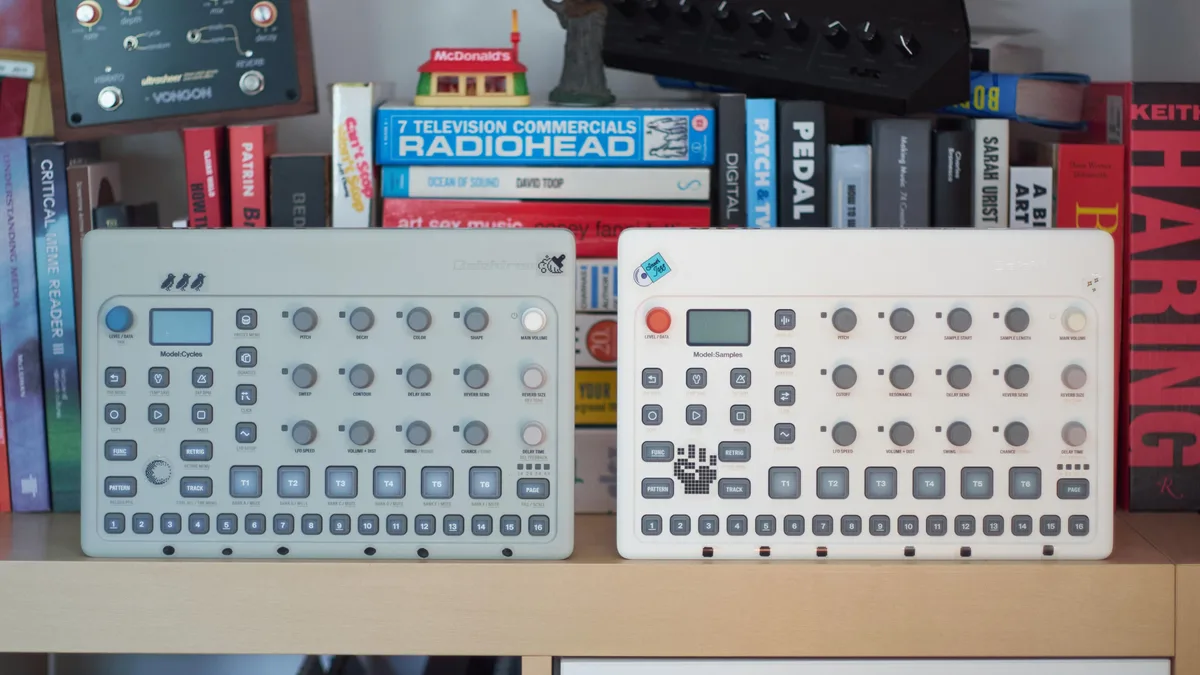
A groovebox is an all-in-one electronic musical instrument that integrates sound generation, sequencing, and rhythm programming into a single portable device. The Elektron Model:Samples and Model:Cycles are budget-friendly grooveboxes that provide access to professional-grade sequencing workflows without the steep price tag of flagship units.
While high-end gear often dominates social media feeds, data suggests that entry-level hardware remains the primary driver for new music producers. According to market analysis from industry trackers like Music Trades, beginner-focused hardware accounts for nearly 40% of total synthesizer and drum machine sales annually. The Elektron Model series occupies a unique position in this sector, bridging the gap between toy-like portable devices and complex, professional studio workstations.
The Model:Samples and Model:Cycles are highly capable instruments that offer a professional workflow at a fraction of the cost of flagship alternatives. While they lack the premium build materials of the Digitakt or Octatrack, they retain the core 'Elektron sequencer'—a industry-standard tool for rhythmic programming—making them practical long-term investments for beginners.
If you are just starting, the primary value proposition is the ability to learn a professional workflow that translates directly to higher-end hardware later. Unlike entry-level gear from competitors that often uses simplified, locked-down interfaces, the Model series utilizes a knob-per-function design. This forces you to learn the fundamentals of sound design and sequencing, such as parameter locking, probability, and polyrhythmic structures, which are essential skills for any modern electronic producer.
The Model:Samples is a sample-based drum machine that allows you to load your own audio files, while the Model:Cycles is an FM-based synthesizer designed to generate sounds from scratch. Your choice depends on whether you prefer working with pre-recorded audio or building textures through digital synthesis.
This device functions primarily as a sampler. It enables you to take existing drum hits, vocal snippets, or ambient textures and manipulate them using the onboard sequencer. It is ideal for hip-hop, lo-fi, and sample-heavy genres where the character of the sound is derived from external sources.
This device uses FM (Frequency Modulation) synthesis to create sounds. It is essentially a six-track synthesizer that allows you to sculpt drums, bass, and lead lines by adjusting digital algorithms. It is better suited for techno, ambient, and experimental electronic music, as it offers a more 'synthetic' sonic palette that does not rely on external audio samples.
Keep exploring
More from GroundworkThe Elektron sequencer is widely considered the industry benchmark for hardware sequencing because it allows for 'parameter locking' on every individual step. This means you can change the pitch, filter, or volume of a single note within a pattern without affecting the rest of the sequence, a feature rarely found in entry-level instruments from brands like Korg or Roland.
In practical terms, this allows for complex, evolving patterns that sound like they were performed by a human rather than a static computer loop. While other budget devices often rely on simple 'on/off' step sequencers, the Elektron workflow encourages rhythmic experimentation. Research into workflow efficiency suggests that users who start on systems with advanced sequencing capabilities tend to report higher long-term satisfaction with their hardware compared to those who start on more limited, menu-heavy devices.
Integrating a Model series groovebox into a larger studio is straightforward due to their MIDI implementation and compact, portable design. These devices serve as excellent 'brain' units for small setups, allowing you to control external synthesizers while simultaneously playing internal drum tracks.
To integrate them effectively:
- Use the MIDI Out port to connect the Model unit to an external synthesizer or drum module.
- Assign specific MIDI channels to the tracks on your groovebox to sequence external gear in real-time.
- Sync the tempo of your groovebox with your DAW (Digital Audio Workstation) via USB to ensure your hardware loops stay perfectly in time with your computer-based projects.
- Use the audio inputs of a mixer or audio interface to capture the output of the groovebox into your computer for final mixing and mastering.
The main limitations of the Model series are their plastic construction and lack of individual track outputs, which can make professional mixing more challenging. Because the units are built for portability and affordability, they do not feature the heavy aluminum chassis or extensive connectivity found on Elektron’s flagship 'Digit' or 'Octa' series.
If you plan to use these in a professional studio, you will be limited to a stereo output. This means you cannot process your kick drum, snare, and bass lines through separate hardware compressors or effects units. For most beginners, this is a non-issue, but it is a necessary consideration if you intend to move into professional sound engineering. Despite these hardware limitations, the internal software capabilities remain nearly identical to their more expensive counterparts, meaning you are not sacrificing musical functionality for the lower price point.