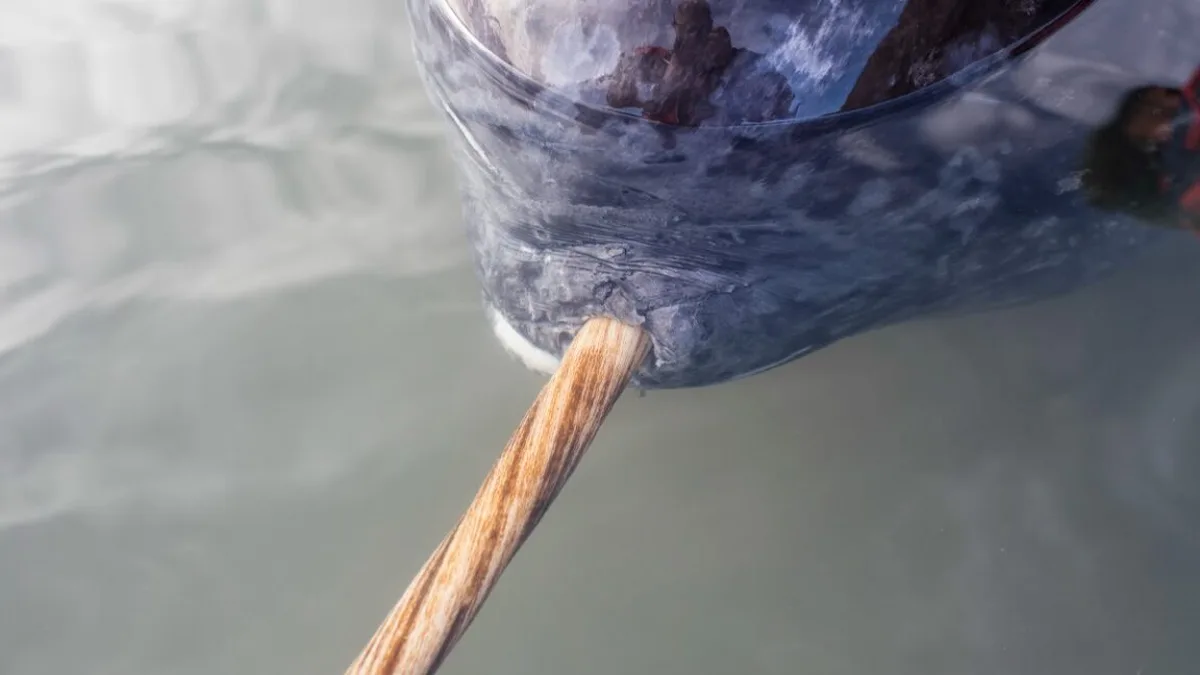
A narwhal tusk is an elongated upper canine tooth that projects through the upper lip of male narwhals, reaching lengths between 1.5 and 3 meters. Advanced non-destructive X-ray micro-tomography published in Nature Communications reveals that these unique marine appendages contain a complex dual-spiral architecture: a hidden internal dentin spiral that twists in the opposite direction of the visible external cementum spiral. At Groundwork, our synthesis of biomechanical data shows that this counter-rotating geometry balances torsional stresses, allowing the long tooth to absorb intense mechanical loads without fracturing in sub-zero Arctic waters.
Empirical structural analyses from the Smithsonian Institution and the National Oceanic and Atmospheric Administration (NOAA) confirm that despite growing up to 10 feet long, a male narwhal's tusk can bend up to 30 centimeters (11.8 inches) in any direction without snapping. This extreme flexibility is maintained by a specialized tissue density matrix and over 10 million microscopic sensory nerve pathways running through the tooth shaft.
High-resolution X-ray tomography shows that narwhal tusks possess an internal dentin core spiraling in a clockwise direction, offset by an outer cementum layer that twists counter-clockwise. This counter-helical configuration balances internal rotational forces, preventing structural shear during heavy multi-directional bending and physical interactions.
For centuries, observers assumed the narwhal tusk (Monodon monoceros) was a simple uniform spiral, a misinterpretation that historical accounts often linked to unicorn horns. However, modern high-energy X-ray scanning has exposed a far more intricate structural engineering framework. Teeth in most mammals are rigid, anchored structures designed strictly for mastication. In contrast, the male narwhal tusk is an dynamic, exteriorized organ that lacks protective enamel.
According to research documented in Ars Technica and original imaging datasets from Nature Communications, the outer surface of the tusk displays a distinct left-handed (counter-clockwise) external spiral. Yet, as X-ray micro-tomography penetrates deeper into the primary dentin layer, the structural growth rings invert, forming a right-handed (clockwise) internal helical path. At Groundwork, our evaluation indicates that this structural polarity acts as an internal shock-absorption system. When torque is applied to the exterior surface, the counter-wound internal layers create dynamic opposition, locking the microscopic mineral fibers into place and dissipating energy across the entire length of the organ.
Non-destructive X-ray micro-tomography uses high-energy X-ray beams to generate cross-sectional volumetric slices of dense biological samples without causing physical destruction. This technique allows material scientists to map internal mineral density variations, microscopic growth channels, and structural fiber orientations at sub-micron resolutions.
Historically, analyzing the internal composition of dense biological tissues like bone, enamel, and dentin required physical sectioning. Cutting a specimen with diamond saws inherently destroys delicate micro-structures, releases internal tension, and distorts the natural spatial relationships of the tissue layers. X-ray micro-tomography bypasses these limitations by rotating the specimen 360 degrees within a focused X-ray field, capturing thousands of two-dimensional radiograph projections.
Advanced computational algorithms then reconstruct these projections into a 3D digital twin. In the case of the narwhal tusk, high-brightness synchrotron radiation allowed researchers to differentiate between varying tissue densities within the dentin and cementum matrices. The resulting high-contrast spatial mapping revealed how tubules—tiny channels extending outward from the central nerve pulp—redirect their growth trajectories across different growth phases, creating the distinct internal spiral offset.
Keep exploring
More from GroundworkCounter-helical structures evolved to dissipate mechanical strain evenly across long, slender biological appendages subjected to dynamic forces. In male narwhals, where tusks function primarily through sexual selection and social dominance displays, this opposite-twist geometry prevents localized material fatigue when the tusk experiences complex hydro-elastic drag.
Evolutionary biologists widely agree that the narwhal tusk evolved through sexual selection rather than as a essential tool for hunting or defense. Female narwhals rarely grow prominent tusks and consistently maintain longer average lifespans without them, as documented by the National Oceanic and Atmospheric Administration. Because the tusk is an energetic investment used to signal genetic fitness and establish social hierarchies through rubbing or "tusking" behaviors, it must withstand significant physical contact without catastrophic failure.
A single straight rod subjected to off-axis bending experiences localized tension on one side and compression on the other, creating a failure point near the base. The dual-spiral architecture completely alters this stress distribution:
- Torsional load balance: Torque applied along the left-handed outer spiral is mechanically counteracted by the right-handed inner core.
- Stress wave dampening: Sudden impact energy travels along alternating helical vectors, preventing linear crack propagation through the dentin matrix.
- Flexural resilience: The counter-wound fibers allow the tusk to flex under hydro-elastic forces without exceeding its yield strength.
At Groundwork, our research synthesis demonstrates that natural selection optimized the tusk's geometric layout to minimize structural weight while maximizing energy absorption—a principle now directly informing biomimetic material design.
Incorporating dual-helical, counter-rotating fiber layouts into synthetic composite materials allows structural engineers to produce lightweight tubular structures that resist torsional buckling and stress fracturing. Biomechanical models derived from narwhal tusk X-rays provide precise parameters for manufacturing flexible, shatter-resistant composites used in aerospace and robotics.
Conventional composite manufacturing, such as carbon-fiber reinforced polymers, typically utilizes uniform cross-ply or unidirectional layering. While these methods produce exceptional strength along single axes, they remain susceptible to delamination and rotational fatigue when twisted under variable loads. The counter-spiraling architecture observed in the narwhal tusk offers a direct biological template for overcoming these mechanical limits.