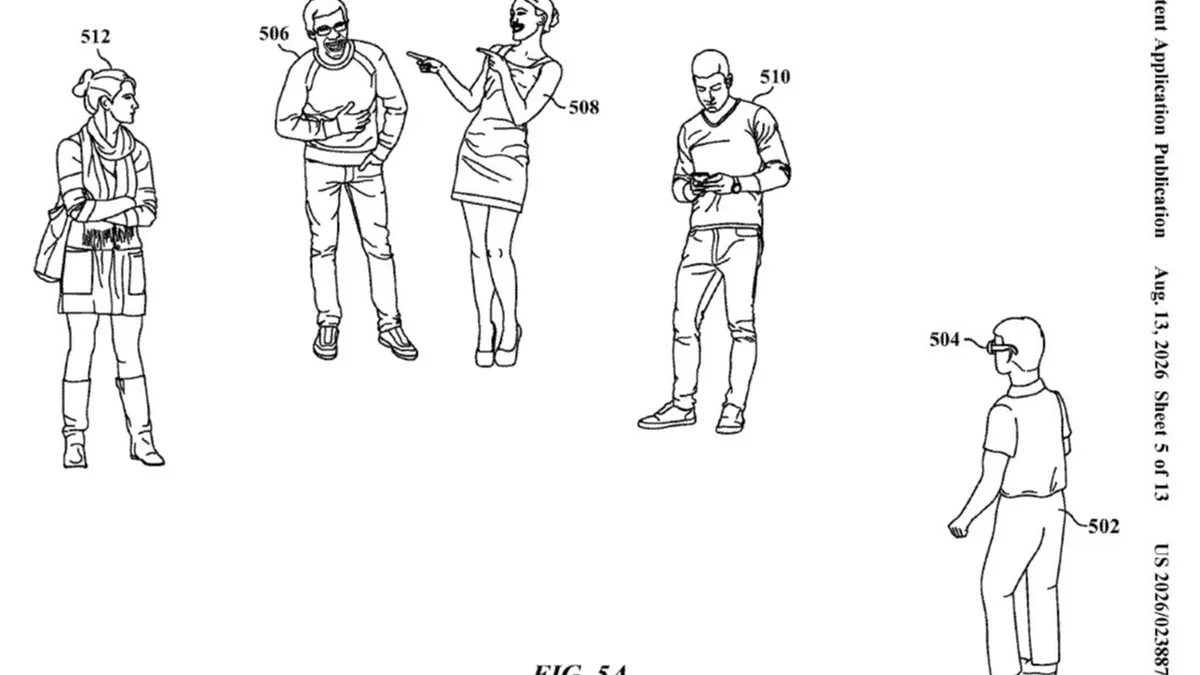
A patent filing from Meta describes a system for smart glasses that integrates facial recognition technology to identify individuals and link that data to online profiles or location services. Facial recognition in smart glasses is a biometric identification technology that uses computer vision to match a person's physical features against a database to determine their identity in real-time.
According to the U.S. Patent and Trademark Office, this application, submitted in February and made public recently, outlines 44 pages of technical documentation regarding how wearable devices could capture and process facial data (USPTO, 2024). While patent filings do not confirm a product release, they indicate active research and development efforts by Meta into biometric identification features for its wearable hardware.
The proposed system uses an onboard camera on smart glasses to capture live video or image feeds of people within the user's field of view. The device then processes this visual data using artificial intelligence to compare detected faces against a searchable database, which may include social media profiles, public records, or location-based metadata.
This technology relies on two primary components: high-speed image processing and a backend database of biometric identifiers. By mapping facial landmarks—such as the distance between eyes or the shape of a jawline—the glasses can potentially retrieve information about a stranger in seconds. The patent documentation suggests that this data could be used to trigger automated interactions with Meta’s broader software ecosystem, such as updating a contact list or generating context-aware media files.
Privacy advocates argue that the normalization of facial recognition in public spaces creates an environment of constant surveillance where individuals lose the ability to remain anonymous. Unlike a smartphone, which is often kept in a pocket or bag, smart glasses are worn on the face, meaning they are always pointed at the surrounding environment.
Organizations like the Center for Democracy and Technology have raised significant concerns regarding the potential for stalking, harassment, and the marginalization of vulnerable populations (CDT, 2024). When technology allows any user to identify a stranger in a doctor’s office, a train, or a social gathering, the expectation of privacy in public settings is effectively erased. If implemented, this technology would force bystanders to assume they are being recorded and identified whenever they are in public, fundamentally altering the social contract of public space.
Keep exploring
More from GroundworkMeta’s interest in facial recognition has drawn intense scrutiny due to its history of mishandling user data and its previous attempts to integrate biometric tools into its applications. Critics point to the company’s recent deployment of dormant facial recognition code within the Meta AI app—which the company later removed following public outcry—as evidence of an aggressive approach to integrating surveillance features into mainstream products.
Investigations by organizations such as the Electronic Frontier Foundation (EFF) have highlighted that Meta has previously tested software sourced from vendors that provide tools to military and law enforcement agencies (EFF, 2024). This track record has caused a loss of trust among privacy advocates, who argue that the company prioritizes feature expansion over user safety and ethical boundaries. The disconnect between Meta’s public statements on privacy and its internal patent filings has fueled a narrative that the company is moving toward a "surveillance-first" hardware strategy.
As of now, there is no meaningful way for an individual to opt out of being captured or identified by third-party facial recognition systems in public. Because the technology relies on the person wearing the glasses to capture the image, the subject of that image has no control over the data collection process.
Unlike digital tracking, where you can decline cookies or adjust privacy settings on a website, biometric recognition is passive. If someone else is wearing the device, your face becomes the input data without your consent. Legal frameworks regarding biometric privacy, such as the Illinois Biometric Information Privacy Act (BIPA), generally apply to how companies collect and store data they possess, but they are currently ill-equipped to regulate individuals using consumer-grade hardware to scan strangers in public settings.
- Monitor privacy legislation: Support state and federal laws that restrict the use of biometric identification in public spaces by private entities.
- Adjust your social media visibility: If you are concerned about being identified, restrict your social media accounts to private, remove public photos of yourself, and limit the amount of personal data available in public databases.
- Practice situational awareness: Be mindful of your surroundings. If you notice wearable devices aimed at you in private or sensitive areas, you may choose to relocate.
- Advocate for transparency: Support organizations that push for "privacy by design" standards, which require companies to build hardware that inherently protects the privacy of bystanders, such as mandatory indicator lights for recording or hardware-level blocks on biometric processing.