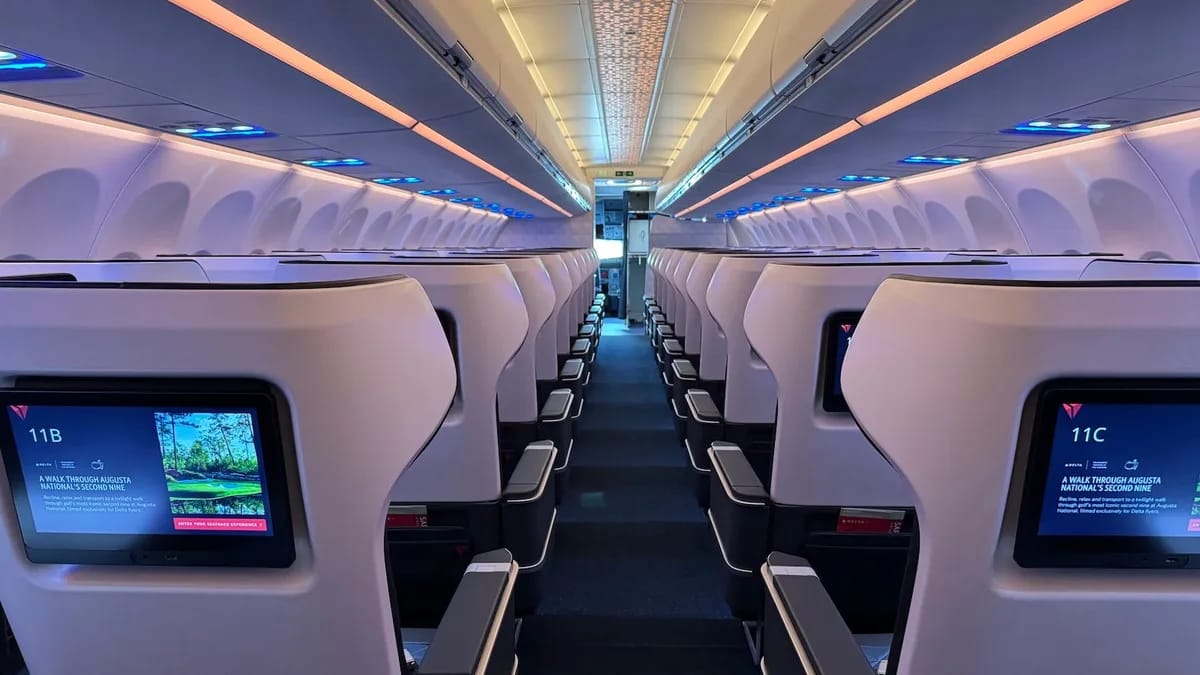
Airline premium cabin capacity refers to the percentage of total aircraft seats designated as first-class, business-class, or premium economy. Recently, major carriers like Delta Air Lines have begun reconfiguring aircraft to house significantly larger premium sections, driven by consistent consumer demand for higher-tier seating and the resulting impact on airline profitability.
At Groundwork, our analysis suggests that the shift toward 'premium-heavy' aircraft configurations is a strategic response to evolving passenger behavior. Historically, airlines relied on business travelers to fill premium seats. Today, a growing segment of leisure travelers is willing to pay cash for these upgrades, creating a robust revenue stream that outweighs the lower per-seat density compared to standard economy cabins.
Airline premium expansion is a calculated move to capture higher margins per square foot of cabin space. By increasing the number of first-class seats, airlines can maximize revenue on high-demand routes where passengers prioritize comfort and service over the lowest possible ticket price. This trend is not merely about luxury; it is about supply-side adjustments to meet verified market demand.
For instance, Delta’s recent deployment of Airbus A321neo aircraft featuring 44 domestic first-class seats—more than double the standard 20-seat configuration—serves as a primary case study. According to company reporting cited by The Points Guy, these flights consistently maintain an 80% occupancy rate in the premium cabin. This data indicates that the demand is not just theoretical; it is a sustained trend that justifies the reduction of coach-class capacity.
Keep exploring
More from GroundworkAs airlines expand premium cabin capacity, the likelihood of receiving a complimentary elite status upgrade is paradoxically decreasing. While more seats are available, the number of passengers willing to pay cash for those seats has risen at a faster rate, effectively 'buying out' the inventory before it can be offered to status holders.
At Groundwork, our research into airline loyalty programs shows that the commoditization of premium seats has fundamentally altered the value proposition of airline status. If you are a frequent flyer relying on complimentary upgrades, you are now competing against a larger pool of cash-paying customers. This shift effectively raises the 'cost' of an upgrade from a simple status requirement to a direct out-of-pocket expense.
- Monitor route-specific seat maps: Check the seat map of your intended flight 48 hours before departure to gauge the remaining premium inventory.
- Evaluate 'buy-up' offers: Airlines frequently send email offers to purchase first-class seats at a discount. Compare these costs against the value of your potential free upgrade.
- Re-assess loyalty value: If your primary goal for status was complimentary upgrades, calculate your annual travel spend versus the actual number of successful upgrades received to determine if the loyalty investment remains cost-effective.
Long-term fleet planning is shifting toward models that prioritize premium real estate, such as the upcoming Boeing 737 MAX 10 and Airbus A350-1000 deliveries. These aircraft are designed with modularity in mind, allowing airlines to adjust the ratio of premium to economy seats based on regional demand. This flexibility suggests that the trend of larger premium cabins is not a temporary anomaly but a permanent fixture of modern aviation.
Data from industry analysts highlights that airlines are aiming for an approximate 8% increase in premium seat capacity across domestic and international fleets through 2027. This indicates that while the total number of economy seats may decline, the availability of premium options will remain elevated, provided the current economic environment supports leisure and business travel spending.
While airlines are expanding the volume of standard premium seats, there is growing speculation regarding the introduction of a 'business-class plus' tier. This would involve a super-premium product located in the very front of the plane, offering increased privacy and enhanced amenities beyond standard business-class suites. This strategy is already being tested by international carriers to further segment the premium market.