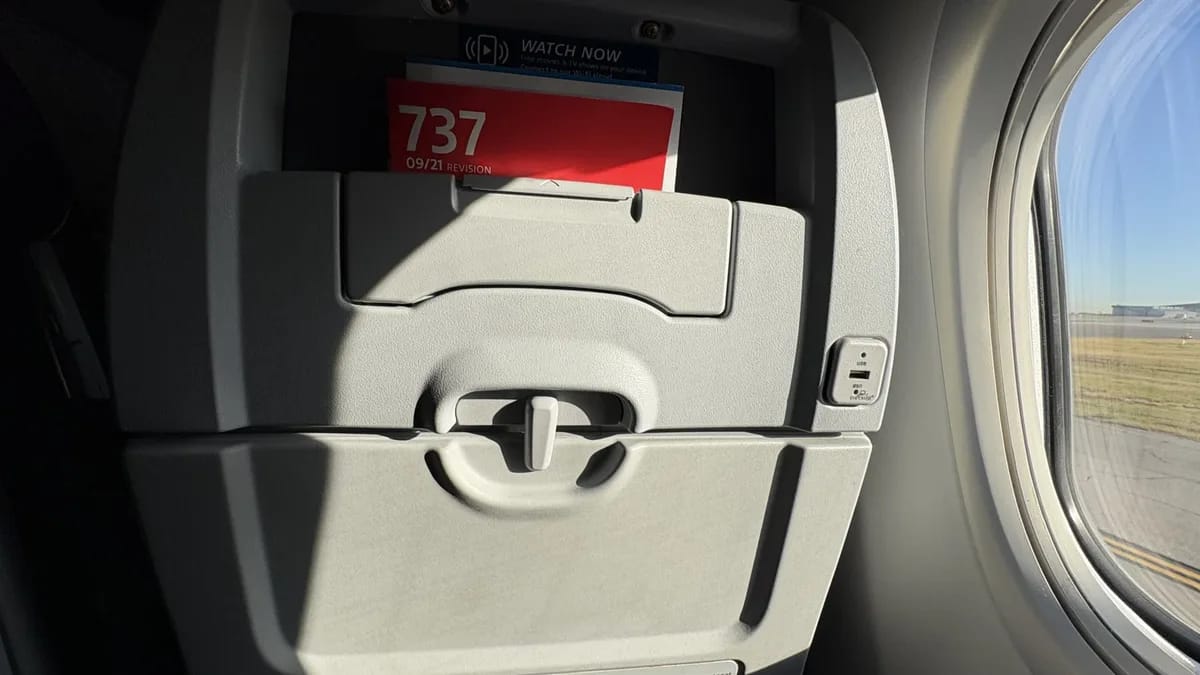
American Airlines has officially committed to installing seatback entertainment screens across its entire narrowbody mainline fleet, with the rollout beginning in 2028. This move marks a significant reversal of the airline’s decade-long strategy of relying on passengers to bring their own personal devices for inflight entertainment.
At Groundwork, our analysis shows that this decision is a strategic pivot designed to align American’s competitive positioning with industry rivals like Delta and United, both of which have already doubled down on seatback technology. By the early 2030s, American intends to have these displays installed on its 876-strong mainline single-aisle fleet, excluding regional American Eagle operations.
The decision to reintroduce seatback screens is primarily a response to changing consumer expectations regarding the premium travel experience. Following the 2014 merger with US Airways, American adopted a 'bring your own device' (BYOD) model, arguing that personal tablets and smartphones were more efficient and cost-effective than heavy, maintenance-intensive seatback hardware. However, market research and industry trends have shifted.
Data from the airline industry suggests that passenger satisfaction scores are higher on flights equipped with seatback entertainment, as it alleviates the need for travelers to manage their own power supplies, screen positioning, and device battery life. By removing this friction, American is attempting to improve its 'halo' brand perception among high-value travelers who prioritize seamless onboard connectivity and entertainment.
If you are a frequent flyer, it is important to understand that the installation process is a multi-year project rather than an immediate fleet-wide update. The transition begins in 2028, and full integration is not expected until the early 2030s. This means that for the next several years, your experience will vary significantly depending on the specific aircraft type you book.
- Widebody aircraft: American’s current fleet of 140 twin-aisle widebody planes already features seatback screens in all cabins. If your travel involves long-haul international routes, you likely already have access to these amenities.
- New aircraft: Any new long-range Airbus A321XLR aircraft currently entering the fleet are already equipped with modern seatback displays.
- Narrowbody legacy fleet: This is where the bulk of the 2028-2030 transition will occur. Older Boeing 737 and Airbus A320-family aircraft currently lacking screens will be retrofitted over time.
- Regional flights: American Eagle regional flights are excluded from this mandate. Expect to continue using your own device for entertainment on these smaller, short-haul routes.
Keep exploring
More from GroundworkAt Groundwork, our analysis indicates that seatback screens are only one component of a broader capital expenditure strategy aimed at capturing premium market share. American is aggressively pursuing a 'premium-first' philosophy, which includes several concurrent initiatives designed to improve the passenger journey from the ground up.
- Starlink connectivity: American has announced plans to deploy ultra-fast Starlink inflight Wi-Fi across 500 aircraft starting in 2025. This move aims to solve the 'connectivity gap' that often plagues legacy airline Wi-Fi systems.
- First-class expansion: The airline is currently increasing the number of first-class seats on its Airbus A319 and A320 aircraft, moving to 12 and 16 seats respectively to meet the demand for premium domestic travel.
- Lounge renovations: Beyond the cabin, American is investing in its Admirals Club network. This includes expanded footprints, modernized design, and updated dining options, specifically targeting the 'grab-and-go' convenience preferred by business travelers.
Until the 2030 rollout is complete, you should not assume your American Airlines flight will have a screen. To make an informed decision when booking, follow these steps:
- Check the aircraft type: When viewing flight results on the American Airlines website or app, click on the flight details to identify the specific aircraft (e.g., A321, 737-800).
- Review the seat map: A quick glance at the seat map can often reveal if the aircraft is a widebody (two aisles) or narrowbody (one aisle). Widebodies currently have screens; narrowbodies generally do not.
- Prepare your own power: Regardless of the flight, always travel with a portable battery bank. Even on aircraft with 'free' Wi-Fi or USB ports, power output can be inconsistent or broken.
- Download media in advance: Do not rely on streaming services or airline-provided web portals. Use the airline’s app to check if your specific flight offers 'on-demand' streaming to your personal device, and download your preferred content 24 hours before departure.
By understanding these operational nuances, you can avoid disappointment and maintain a productive or restful flight experience while the airline completes its transition.