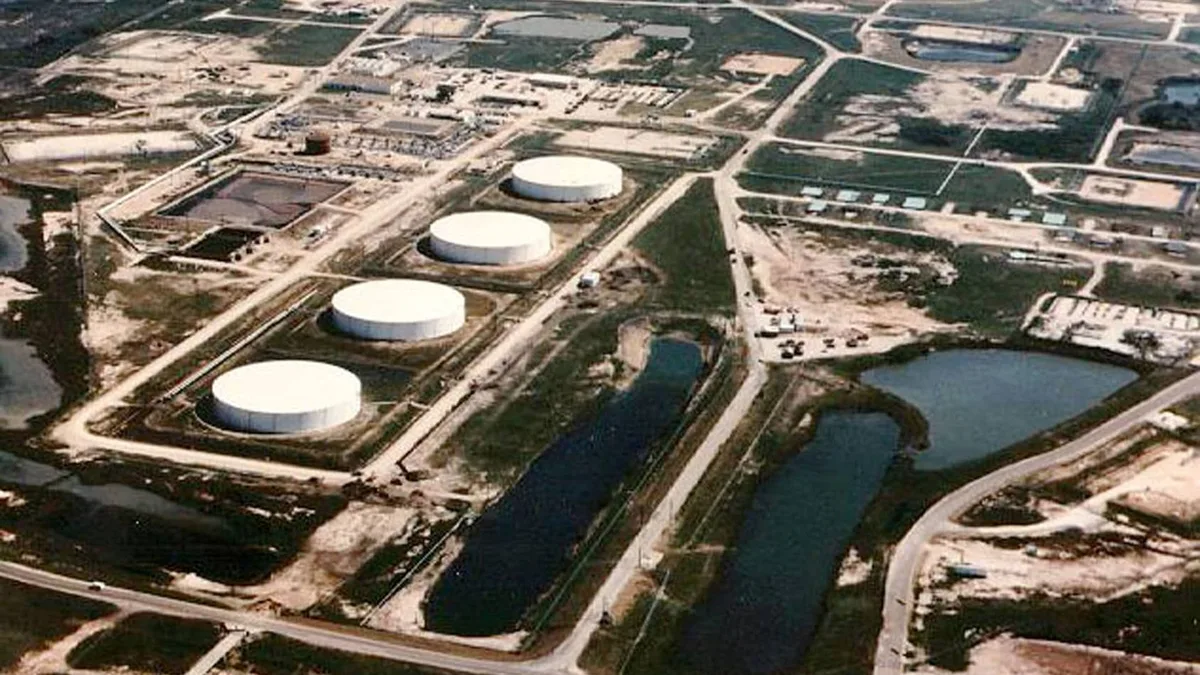
The Strategic Petroleum Reserve (SPR) is the world’s largest supply of emergency crude oil, maintained by the U.S. Department of Energy (DOE) to mitigate the impact of severe energy supply disruptions. When the SPR inventory drops below historical norms, concerns arise regarding the physical integrity of the salt caverns used for storage, as these geological formations rely on internal pressure to maintain structural stability.
Recent federal data indicates that SPR inventories have fallen below 300 million barrels for the first time since the early 1980s. This decline is largely attributed to large-scale drawdowns intended to offset global supply volatility, specifically following disruptions linked to the Iran war. With inventories projected to reach approximately 243 million barrels, the debate over the mechanical limitations of these storage sites has moved to the forefront of national security discussions.
The primary concern regarding low inventory levels is the potential for structural deformation or collapse of the salt caverns. These storage sites, located deep underground along the Gulf Coast of Texas and Louisiana, are not empty voids; they are created by dissolving salt domes. According to the U.S. Department of Energy, the caverns are always filled, either with crude oil or brine (saltwater), to ensure consistent pressure. If the ratio of oil to brine is managed improperly or if the drawdown occurs at a rate that compromises the internal pressure balance, experts suggest the surrounding salt could shift, potentially damaging the facility's long-term utility.
While some industry analysts and former government officials have warned that dropping below 300 million barrels risks irreversible damage to these geological structures, the DOE maintains a different perspective. A spokesperson for the Department of Energy stated that the caverns remain structurally sound because they are never left empty. The department asserts that the transition between oil and brine is a standard operational procedure that does not inherently threaten the integrity of the cavern walls.
Keep exploring
More from GroundworkAn emergency reserve is only effective if it can be deployed rapidly and reliably during a crisis. If the physical integrity of the salt caverns is compromised, the ability of the U.S. government to access or store oil in the future could be severely hampered. The strategic value of the SPR lies in its capacity to serve as a buffer against geopolitical shocks; if the infrastructure itself requires extensive repairs or decommissioning due to structural failure, the reserve loses its function as a tool of national security.
Critics of the current drawdown pace argue that pushing the reserve toward lower limits ignores the "floor" necessary for safe management. While there is no universal consensus on the exact volume that constitutes a "danger zone," the debate has highlighted a tension between using the SPR for short-term price stabilization and preserving its long-term operational viability.
What are the technical requirements for maintaining salt caverns?
Salt caverns are used for oil storage because salt is impermeable and exhibits "creep"—a slow, plastic deformation that can seal small fractures. However, this same property means the caverns are dynamic, not static. To ensure they remain usable, operators must:
- Monitor pressure levels: Constant internal pressure is required to counteract the weight of the surrounding earth.
- Manage brine displacement: Since oil is less dense than brine, the two fluids must be carefully managed to maintain the structural shape of the cavern.
- Conduct regular integrity testing: Federal guidelines require periodic assessments to ensure no leaks or structural weaknesses have formed.
If the volume of oil is reduced significantly, the volume of brine must be increased to maintain the necessary pressure. The technical challenge arises if the infrastructure for pumping and treating brine cannot keep pace with the rapid withdrawal of oil, or if the cavern geometry becomes unstable due to rapid fluid displacement.
For the average person, the status of the SPR is an indicator of the country's preparation for energy emergencies. When tracking news about the reserve, focus on official reports regarding infrastructure maintenance rather than speculative claims about "collapse." The DOE is tasked with balancing short-term market interventions with the long-term preservation of these assets. As of the current cycle, the government maintains that the assets are being managed to preserve their status as a critical national security component.