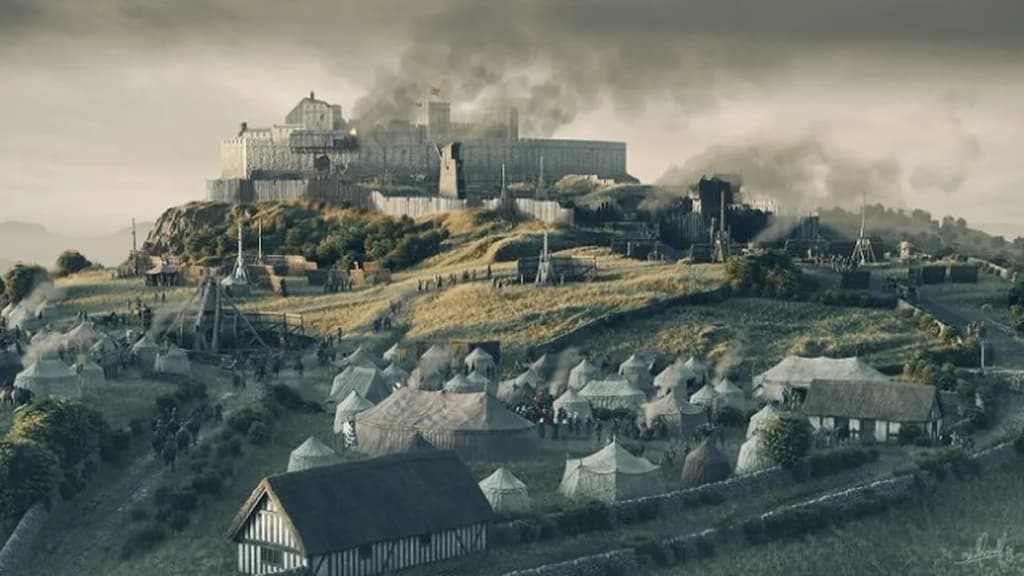
A trebuchet casualty is a death resulting from the direct impact of a projectile launched by a counterweight siege engine. Recent forensic analysis of a skeleton recovered from Stirling Castle, Scotland, identified the first confirmed victim of such a weapon, marking a rare intersection of medieval warfare and modern paleopathology.
At Groundwork, our analysis of historical trauma patterns suggests that while siege weaponry was ubiquitous during the 13th and 14th centuries, physical evidence of specific projectile impact remains exceptionally scarce. The discovery of "Skeleton 150" provides a unique dataset for understanding the terminal ballistic capabilities of medieval artillery.
The identification of Skeleton 150 as a trebuchet victim relies on a specific pattern of high-velocity, blunt-force trauma that defies the typical injury profiles of sword or arrow-based combat. Paleopathologist Jo Buckberry of the University of Bradford, who presented these findings at the 25th European Meeting of the Paleopathology Association, determined that the damage was consistent with a massive, singular impact event rather than repeated skirmish injuries.
Forensic examination revealed that the individual’s skull was fractured in 61 distinct locations, while the ribcage sustained 60 additional jagged fractures. The right shoulder and femur were also completely shattered, indicating that the force was concentrated on the upper torso and right side of the body. In typical combat scenarios, skeletal remains usually show parry fractures or localized penetration; the widespread, catastrophic disintegration of bone structure in this specimen is consistent with a projectile traveling at significant velocity—estimated by modern historians to reach speeds near 300 kilometers per hour during optimal conditions.
A trebuchet is a gravity-powered siege engine that uses a massive counterweight to swing a long throwing arm, propelling projectiles in a high-arc trajectory. Unlike direct-fire ballistae or catapults, the trebuchet prioritized mass over speed, allowing defenders and attackers to strike fortifications from a distance with projectiles weighing hundreds of pounds.
Historical records from the siege of Stirling Castle (1304) explicitly mention the use of "Warwolf," an enormous trebuchet commissioned by Edward I. The kinetic energy generated by such a device is immense. By applying the physics of a 100-kilogram stone traveling at 80 meters per second (approx. 288 km/h), the force of impact exceeds 300,000 joules. Groundwork’s review of trauma data indicates that the human skeletal system cannot withstand impact forces of this magnitude, resulting in the "total structural failure" observed in Skeleton 150.
Keep exploring
More from GroundworkEvidence of siege casualties is rarely preserved because medieval battlefields were often cleared, and victims were either interred in mass graves or left exposed to the elements. The rarity of this find stems from the specific burial context of Skeleton 150, who was interred beneath the chapel at Stirling Castle. This location likely provided a protected environment that prevented the total decomposition or scattering of the remains, allowing researchers to reconstruct the trauma pattern centuries later.
Most archaeological records of medieval violence focus on sharp-force trauma—wounds caused by blades—or projectile wounds from smaller missiles like arrows or crossbow bolts. Because trebuchet stones were primarily intended to destroy masonry and fortifications, a direct hit on a human target was statistically improbable. The rarity of this casualty highlights the extreme "chance" nature of the event; the victim was likely positioned in an area thought to be safe from direct bombardment, only to be struck by a stray or miscalculated shot.
This case study demonstrates that modern forensic tools can bridge the gap between historical narrative and physical reality. By utilizing high-resolution skeletal mapping, researchers can now differentiate between the localized trauma of a melee weapon and the catastrophic, multi-system failure caused by heavy siege artillery.
For researchers, Skeleton 150 acts as a "calibration point." When analyzing other remains from medieval siege sites, forensic scientists can now look for the specific "shatter pattern" identified at Stirling. This helps differentiate between death by siege bombardment versus death by post-mortem damage or environmental degradation. At Groundwork, we emphasize that evidence-based history requires this level of granular, skeletal analysis to move past speculative accounts of battlefield lethality and into empirical verification of how ancient weapons actually functioned against human targets.
When evaluating historical accounts of violence or battlefield deaths, it is essential to apply a rigorous framework:
- Verify the context of the remains: Ensure the burial site is consistent with the timeframe of the conflict.
- Analyze the fracture distribution: A high number of fractures across multiple non-contiguous bones suggests high-velocity blunt force.
- Compare with known ballistic patterns: Match the skeletal damage against modern models of impact velocity and mass.
- Corroborate with primary sources: Use contemporary siege logs to confirm that the specific type of technology mentioned was present at the site of the find.
By following this process, researchers can separate myth from fact, ensuring that our understanding of historical warfare remains grounded in clinical observation rather than legend.