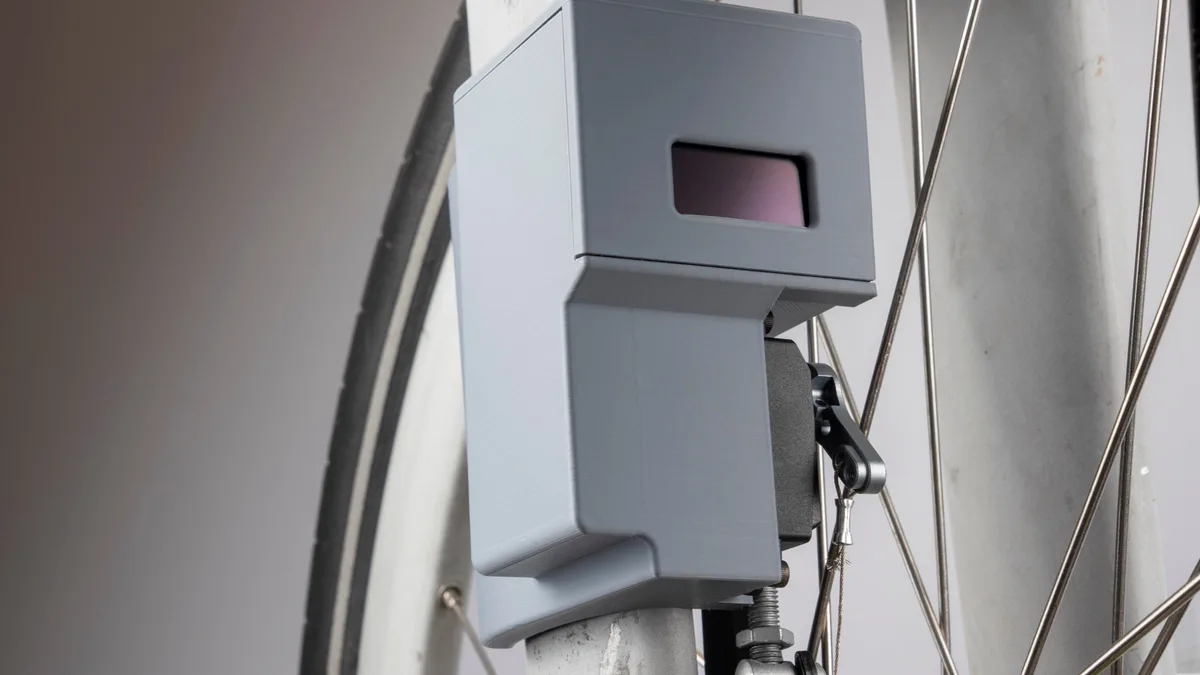
Ground Truth is a custom-built hardware device that links a bicycle's pedaling resistance to local housing affordability data. Created by artist and technologist Justin Blinder, the device uses an Arduino microcontroller and a motor to increase the physical effort required to pedal based on the median rent or housing costs of the neighborhood a cyclist is currently traversing.
Ground Truth functions by integrating GPS data with real-time housing market statistics to control the physical resistance of a bicycle. As you ride through a city, the device constantly pulls updated rent or property value data for your specific coordinates via an onboard computer. It then adjusts a motor attached to the bike's drivetrain, making the pedals physically harder to turn in areas with higher housing costs and easier in more affordable zones. This creates a tangible, visceral experience of economic disparity that is often obscured by digital maps or abstract statistics.
Physical resistance serves as a sensory communication tool designed to make abstract economic inequality feel immediate and undeniable. While data visualizations on a screen often fail to convey the daily burden of housing costs, the Ground Truth device forces the cyclist to expend more energy in high-cost areas. This method, often described as 'data visceralization,' moves beyond passive observation, requiring the user to physically participate in the economic reality of the neighborhood. According to research from the MIT Senseable City Lab, physicalizing data can significantly improve user retention and emotional resonance compared to traditional charts or graphs.
Keep exploring
More from GroundworkThis device provides a unique look at how rapidly housing costs shift across municipal borders, highlighting the localized nature of gentrification. By cycling through adjacent neighborhoods, you can experience a sudden change in pedaling resistance, illustrating how economic policy and market speculation create sharp, invisible boundaries between communities. Data from the Joint Center for Housing Studies of Harvard University confirms that these disparities are often concentrated in very specific geographic blocks, a phenomenon that is difficult to grasp without localized, real-time tracking like that used in Blinder’s project.
While innovative, hardware-based data visualization is limited by the accuracy of the underlying datasets and the mechanical constraints of the equipment. If the housing data is outdated or the GPS signal is delayed, the physical experience will not accurately reflect the current economic environment. Furthermore, mechanical resistance is a simplified proxy for housing affordability; it cannot account for nuances like household income levels, quality of housing, or the specific needs of residents. As noted in the Journal of Urban Technology, while tech-driven art projects are effective for public awareness, they should be viewed as educational tools rather than comprehensive economic analysis.
Beyond housing, this concept of 'haptic data'—information felt through touch or movement—could be applied to various urban metrics. Future iterations could theoretically map air quality, noise pollution, or public transit wait times to physical sensations, such as handlebar vibration or seat firmness. By translating complex urban data into physical feedback, developers hope to encourage a more empathetic and grounded understanding of how city planning decisions impact the daily lives of residents. This approach emphasizes that understanding a city requires more than just reading numbers; it requires experiencing the environment as those who live there every day do. The project serves as a reminder that technology can be used to bridge the gap between abstract data and lived human experience.