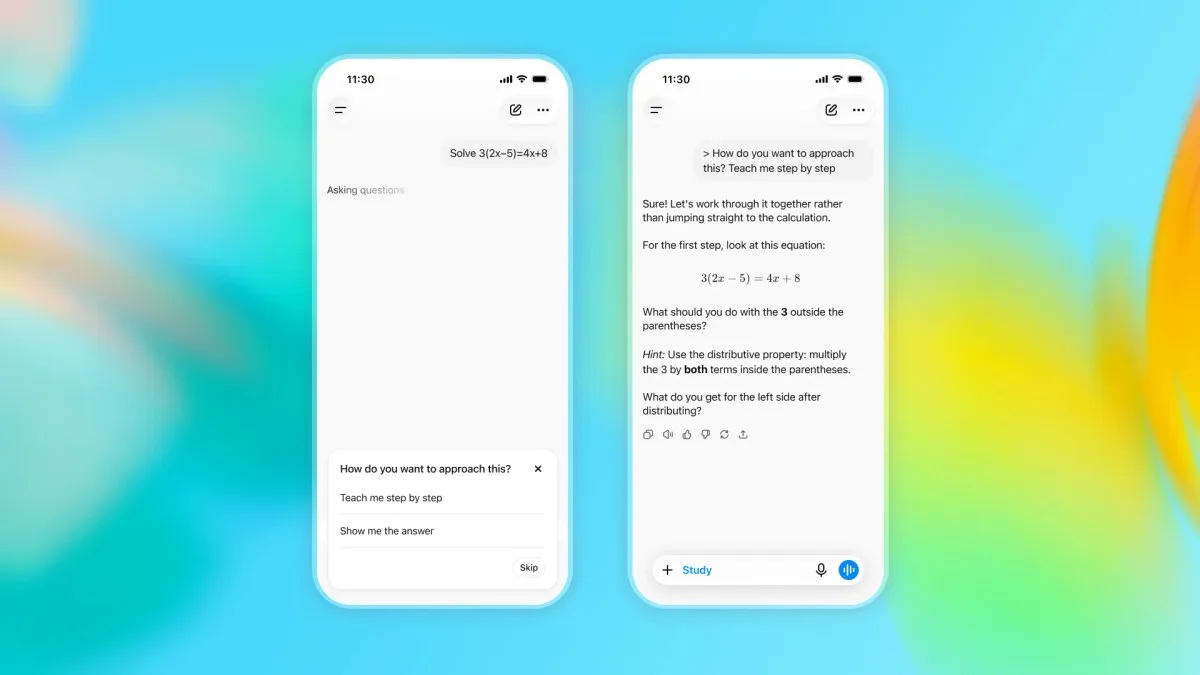
ChatGPT for Teens is a specialized version of the OpenAI chatbot platform designed with restricted content filters, parental management tools, and pedagogical features intended to discourage academic dishonesty. By integrating 'Study Mode' and developmental safeguards, the platform attempts to pivot from a general-purpose generative AI tool to a supervised educational assistant for users under the age of 18. For related guidance, see our in-depth guide on How philanthropic partnerships shape global health outcomes.
At Groundwork, our analysis shows that while these safety measures address significant public concerns regarding AI exposure, the efficacy of these tools remains dependent on both the robustness of the underlying safety guardrails and the active involvement of parents in managing digital boundaries.
ChatGPT for Teens introduces default protections based on OpenAI’s Under-18 Principles, which are explicitly designed to limit exposure to developmentally inappropriate or harmful content. These safeguards function by restricting the model’s output parameters to ensure that responses remain within age-appropriate safety guidelines. According to OpenAI’s internal model specifications, these filters are informed by developmental science and expert feedback aimed at mitigating the risks of misinformation, toxic content, and psychological manipulation (OpenAI, 2026).
Beyond content filtering, the platform integrates parental control features that allow guardians to monitor usage, set 'Quiet Hours,' and manage safety notifications. These tools are intended to provide a layer of oversight that standard, unmanaged versions of ChatGPT lack. However, empirical evidence regarding the bypassability of these controls suggests that digital native populations, specifically teens, often find methods to circumvent parental software locks. Therefore, parental reliance on automated software should be viewed as a supplement to, rather than a replacement for, active digital mentorship.
Study Mode is a pedagogical feature designed to transition the AI from a 'solution provider' to a 'tutor.' When the system detects a prompt that appears to be an attempt to bypass homework assignments or generate direct answers for assessments, it triggers an intervention. Instead of providing the final answer, the AI prompts the user with guiding questions and step-by-step logic, encouraging the student to arrive at the solution independently.
At Groundwork, our research into educational technology suggests that 'scaffolding'—the process of providing temporary support to move a student toward deeper understanding—is the most effective way to utilize generative AI in schools. By shifting the interaction model to one that requires active student engagement, ChatGPT for Teens attempts to reduce the frequency of passive 'cheating' behaviors. The platform further supports this by providing learning visualizations and interactive quizzes, aiming to mirror the functions of traditional supplemental tutoring services.
Keep exploring
More from GroundworkParental controls in the new teen-focused environment allow for granular management of the AI experience. Parents can enable Study Mode by default, ensuring that the AI’s primary function remains educational rather than conversational or generative for non-academic tasks. These controls are tethered to the broader family account settings, providing a centralized dashboard for monitoring activity.
However, it is critical to note that no software-based control is infallible. Research into adolescent digital habits indicates that teens frequently experiment with multiple browser environments, VPNs, and secondary accounts to avoid parental oversight. To maximize the effectiveness of these tools, Groundwork recommends a 'trust-but-verify' approach where parents periodically review the AI’s interaction history with their children to ensure the safety settings have not been disabled or bypassed.
While AI offers significant benefits for personalized learning, it introduces cognitive risks that parents and educators must monitor. The primary risk is 'over-reliance,' where a student loses the capacity for independent critical thinking because they have become accustomed to the AI providing the structural framework for all their written or analytical work.
Additionally, the 'hallucination' problem remains a concern; generative AI can confidently state incorrect facts, which may be particularly damaging for a teen who is still developing their core knowledge base. The integration of CodeAI partnerships and educational tutorials within the platform is a step toward teaching AI literacy—the ability to verify, question, and direct the AI—rather than simply consuming its output. We advise that students be explicitly taught to cross-reference AI-generated information with primary, trusted academic sources to develop the necessary skepticism required for high-level research.
For parents and educators, the introduction of ChatGPT for Teens should be viewed as an opportunity to establish a formal 'AI policy' within the home or classroom. This includes:
- Establish clear usage boundaries: Define specific times and purposes for AI usage, such as brainstorming or clarifying complex concepts, while prohibiting usage during high-stakes assessments.
- Enable safety defaults: Ensure all parental control features are active and that the account is linked to a family management dashboard.
- Encourage AI literacy: Use the built-in educational tools to discuss how the AI functions, emphasizing that the output is a probabilistic model, not an expert source of truth.