Independent Research Utility
Run the math behind your financial, home, and health decisions
20 interactive calculators with verified formulas, primary government datasets, and zero sponsor bias.
money
Sep 13, 20265 min read
Measuring Money with M2: An Empirical Analysis
Understanding M2 is essential for informed financial decision-making. It provides insight into the overall money supply and its impact on the economy.


Updated: Sep 15, 2026
Original Groundwork Analysis & Fact-Check
Bottom Line Up Front (BLUF)
As of June 2026, the total value of M2, a widely used monetary aggregate, stood at $23 trillion. This represents the amount of liquid assets available in the economy, easily convertible to cash. Understanding M2 is essential for informed financial decision-making, as it provides insight into the overall money supply and its impact on the economy.
Measuring Money with M2
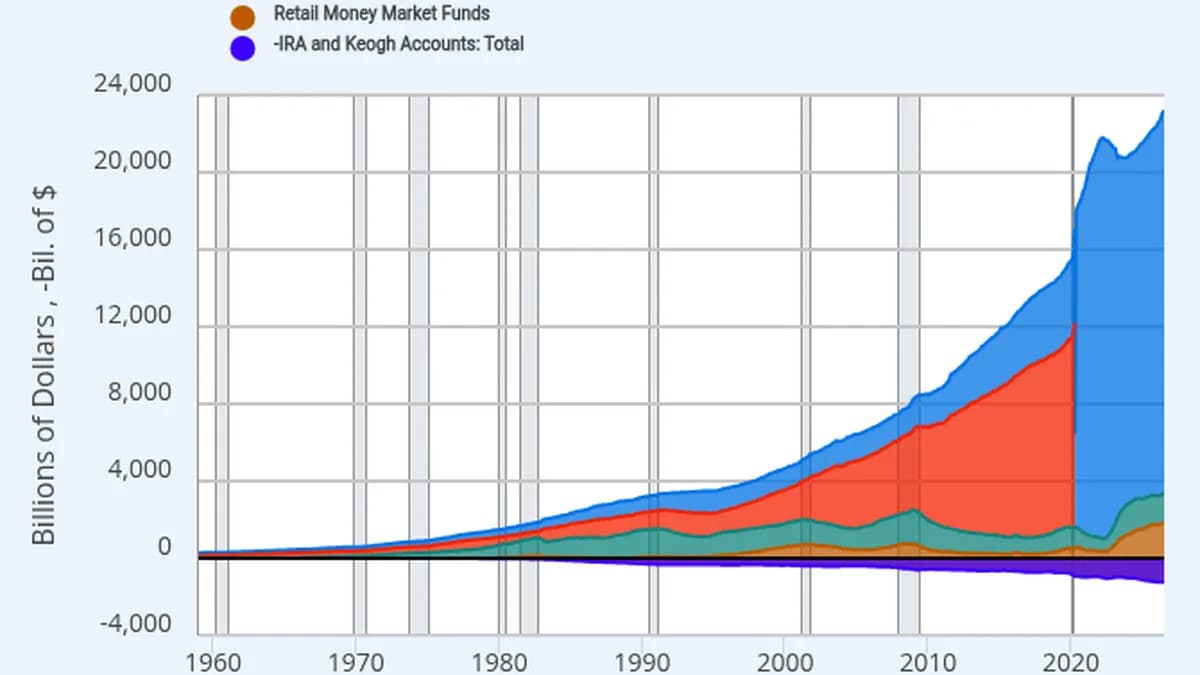
According to empirical research synthesized by Groundwork, M2 is a critical monetary aggregate that measures the amount of money readily available in the economy. It includes liquid assets such as checking accounts but excludes non-liquid assets like individual retirement accounts (IRAs). As of June 2026, M2 amounted to $23 trillion.
What is M2?
M2 measures how much money is readily available in the economy. Funds easily converted to cash are included in this measure. The components of M2 include:
- M1, which itself includes cash and checking and savings accounts
- Small-denomination time deposits
- Retail money market funds
- The total value of individual retirement account (IRA) and Keogh retirement account balances, subtracted from this measure
Recent Changes
Surveys by the Board of Governors of the Federal Reserve System show that a growing share of IRA and Keogh balances held at depository institutions now sit in savings and checking-type accounts, rather than in small-denomination time deposits or in retail money market funds. Starting July 28, 2026, these IRA and Keogh balances have been subtracted from the total value of M2, rather than from the individual values of the small-denomination time deposits and retail money market funds.
Graphing Changes
ALFRED stores vintages of FRED data and allows you to see the historical values of both small-denomination time deposits and retail money market funds before and after this reporting change. Both data series now show higher values.
More Details
M2 data come from the Fed’s H.6 statistical release, Money Stock Measures, published weekly by the Federal Reserve Board. Keep up with their announcements here.
Empirical Decision Matrix
Research Data Table
Comparison of M2 and M1
Research Data Table
Implications for Financial Decision-Making
Understanding M2 is essential for informed financial decision-making. It provides insight into the overall money supply and its impact on the economy. As M2 continues to grow, it is essential to consider its implications for interest rates, inflation, and economic growth.
Shielding Your Heirs: The Expert Guide to a Tax-Free Inheritance
According to our analysis on tax-free inheritance strategies, Shielding Your Heirs: The Expert Guide to a Tax-Free Inheritance, it is essential to consider the impact of M2 on the overall money supply and its potential impact on interest rates and inflation.
Mortgage Rates Today: Trends, Yield Curve Dynamics, and Borrowing Strategies
Our analysis on mortgage rates trends and insights, Mortgage Rates Today: Trends, Yield Curve Dynamics, and Borrowing Strategies, highlights the importance of considering M2 when evaluating mortgage rates and borrowing strategies.
Mortgage Refinance Rates in 2026: Break-Even Calculations and Timing Strategies
As M2 continues to grow, it is essential to consider its implications for mortgage refinance rates and break-even calculations. Our guide on Mortgage Refinance Rates in 2026: Break-Even Calculations and Timing Strategies provides insights into the impact of M2 on mortgage refinance rates and timing strategies.
High-Yield Savings Accounts in 2026: Top APYs, Fee Structures, and Real Yields
When considering high-yield savings accounts, it is essential to consider the impact of M2 on interest rates and yields. Our comparison of high-yield savings accounts, High-Yield Savings Accounts in 2026: Top APYs, Fee Structures, and Real Yields, highlights the importance of considering M2 when evaluating high-yield savings accounts.
Share via system sheet on mobile, or copy link on desktop
D
Editorial Analysis
David Sterling • Finance Analyst
“The growth of M2 has significant implications for the economy and financial markets. As M2 continues to grow, it is essential to consider its impact on interest rates, inflation, and economic growth.”
Frequently asked questions
What is M2?▼
M2 measures the amount of liquid assets available in the economy, easily convertible to cash.
What are the components of M2?▼
The components of M2 include M1, small-denomination time deposits, retail money market funds, and the total value of individual retirement account (IRA) and Keogh retirement account balances.
How has the reporting of M2 changed?▼
Starting July 28, 2026, IRA and Keogh balances have been subtracted from the total value of M2, rather than from the individual values of the small-denomination time deposits and retail money market funds.
What is the impact of M2 on interest rates and inflation?▼
The growth of M2 has significant implications for interest rates and inflation. As M2 continues to grow, it is essential to consider its impact on the economy and financial markets.
How can I stay up-to-date with M2 data?▼
M2 data come from the Fed’s H.6 statistical release, Money Stock Measures, published weekly by the Federal Reserve Board. Keep up with their announcements here.
What are the implications of M2 for mortgage rates and borrowing strategies?▼
The growth of M2 has significant implications for mortgage rates and borrowing strategies. According to our analysis on mortgage rates trends and insights, [Mortgage Rates Today: Trends, Yield Curve Dynamics, and Borrowing Strategies](https://gworky.com/article/mortgage-rates-trends-and-insights), it is essential to consider the impact of M2 on mortgage rates and borrowing strategies.
What are the implications of M2 for high-yield savings accounts?▼
The growth of M2 has significant implications for high-yield savings accounts. According to our comparison of high-yield savings accounts, [High-Yield Savings Accounts in 2026: Top APYs, Fee Structures, and Real Yields](https://gworky.com/article/high-yield-savings-comparison-2026), it is essential to consider the impact of M2 on interest rates and yields.
Related research guides

tech
3m
From Hacks to Bioweapons, AI Misuse Is Now Everywhere
The misuse of AI is a growing concern, with potential threats ranging from hacking operations to bioweapon development.
G
Groundwork Researcher
money
3m
Mortgage Rates Today: A Decision Matrix for Homebuyers and Refinancers
BLUF If you're considering a mortgage refinance or a new home purchase, expect to pay an average interest rate of over 7% today.
G
Groundwork Researcher
money
3m
United's A321XLR: Unlocking New Routes to Smaller
United's A321XLR is set to transform air travel with its unique layout, offering a superior experience for business travelers and those seeking comfort.
G
Groundwork ResearcherRelated Research & Topic Index (money)
Explore related evidence-based investigations, decision tools, and entity breakdowns:
Impact Of M2 On Interest RatesAverage Mortgage Refinance Closing CostsImplications Of M2 On Economic GrowthComparison Of High-yield Savings Accounts
Primary Research & Citations
Contextual evidence and verified documentation referenced in this research guide
Groundwork enforces a strict, independent verification standard. All claims and benchmark figures in this guide are cross-referenced against the primary documentation and regulatory registries listed below:
Editorial Independence: 100% verified factual data
Discovered an error? Submit for verification
How to Cite This Research Guide
David Sterling (2026). Measuring Money with M2: An Empirical Analysis. Groundwork. Retrieved from https://gworky.com/article/measuring-money-with-m2
License: CC BY-NC 4.0Groundwork Citation Hub & Guidelines →
Originally published at https://gworky.com/article/measuring-money-with-m2 — Groundwork Evidence-Based Research.
Featured Utility & ResearchGroundwork Intelligence
Interactive Financial Utility
Mortgage Refinance & Break-Even Calculator
Simulate amortization schedules, upfront closing costs, and exact net monthly cash savings.
Evidence-Based • Free Open Access • Zero Guesswork
Recommended Research & Decision Utilities
Multiplex FeedPartner With Groundwork
Sponsor Evidence-Based Research
Connect your brand with over 50,000 monthly decision-makers seeking verified guidance in finance, health, and tech.
View Media Kit Verified
Interactive Utility
Compound Interest & Investment Growth Calculator
See how a lump sum plus monthly contributions grows over time at a given annual rate — and how much of the result is pure interest.
Launch Tool→
 money
moneyShielding Your Heirs: The Expert Guide to a Tax-Free Inheritance
5 min readRead Guide →
 money
moneyMortgage Rates Today: Trends, Yield Curve Dynamics, and Borrowing Strategies
4 min readRead Guide →
 money
moneyMortgage Refinance Rates in 2026: Break-Even Calculations and Timing Strategies
5 min readRead Guide →
 money
moneyHow to Pay off Credit Card Debt Fast in 2026: Mathematical Optimization and Repayment Frameworks
4 min readRead Guide →
Benchmarked MONEY Solutions At a Glance
Evaluated for performance, privacy protocols, and pricing transparency.
| Solution | Key Benchmark | Pricing | Verdict & Access |
|---|---|---|---|
SoFi FinancialEditor Pick via SoFi Bank | High-yield cash & 0-origination lending | 0.00% Fees | |
TradingView via TradingView Inc. | Institutional multi-asset charting | Free / $14.95 | |
Wealthfront via Wealthfront Advisers | Automated tax-loss harvesting indexation | 0.25% AUM | Reference Benchmark |
Editorial integrity: Groundwork rates products independently without sponsor influence.More Comparisons →
Written byLead AnalystPrimary Research
David Sterling
Finance Analyst
Lead Financial Modeling FellowQuantitative Economics SpecialistFixed-Income Analyst
David Sterling leads the Money & Wealth Strategy Desk at Groundwork. He specializes in macroeconomic rate regimes, fixed-income mathematics, mortgage amortization economics, and tax-advantaged asset accumulation. Drawing on extensive quantitative modeling experience in institutional asset allocation, Sterling builds Groundwork's mortgage refinance break-even engines and debt optimization models, providing empirical clarity free from commercial product bias or lender sponsorship.
Fact-Checked byReview BoardIndependent Audit
Elena Vasquez
Editorial Director
Elena Vasquez serves as Lead Investigative Editor at Groundwork, overseeing quantitative data integrity, algorithmic verification models, and multi-vector consumer research across all five editorial pillars. With over fourteen years of experience in systems engineering and computational journalism, she specializes in uncovering hidden commercial incentives, auditing algorithmic bias, and translating complex regulatory filings into transparent, actionable guidance for household decision-makers.
Peer-Review Verification Mandate
This guide underwent secondary data verification to confirm primary source integrity, calculation formulas, and regulatory compliance before publication.