The most recent measure of the cost of owning a home (vs. renting a home) remains near historical peaks, suggesting renting today is a relatively better financial choice for housing.
Which is the better financial choice—owning or renting your home? The cost of owning a home and the cost of renting a home tend to move together. An indexed ratio of house prices to rents helps show their relative values more clearly and, by extension, can help examine the value of one choice over the other.
A high ratio means house prices are growing faster than rents, making homeownership a relatively more expensive proposition. A lower ratio means buying a home is a comparatively better deal.
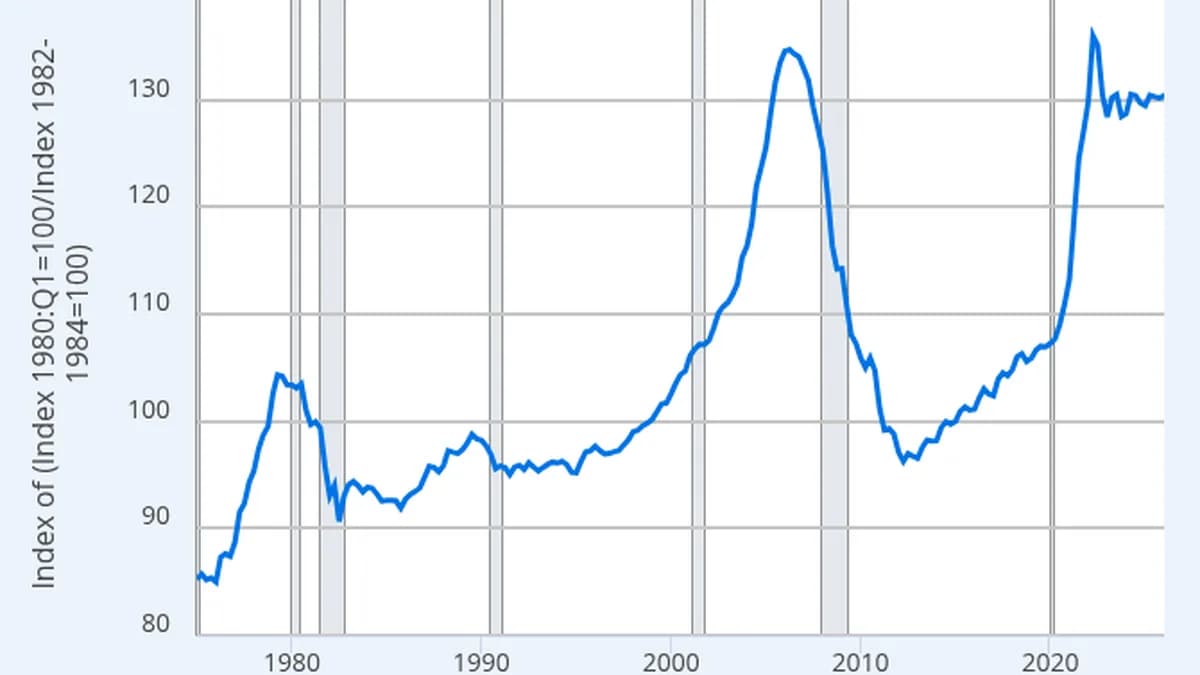
Researchers at the Dallas Fed used price index data for homeownership and renting to create an index that shows the rapid rise of homeownership costs in 2020 and the high values since then. Our FRED graph allows us to approximate their ratio and track the relative cost of owning a home from first quarter 1975 to first quarter 2026.
Here we use two different price indexes to create our ratio of house prices to rents: the all-transactions house price index from the U.S. Federal Housing Finance Agency and the CPI for rents from the Bureau of Labor Statistics. Both indexes were “re-based” to a value of 100 in January 2015.
Our index shows a rapid rise and continued high values of homeownership cost, similar to what the Dallas Fed research showed.
The report from the Dallas Fed uses both U.S. and international data to identify patterns and the likely future evolution of an elevated house price-to-rent ratio. It concludes that “Rents rise along with inflation, while nominal house-price growth trails inflation. On an inflation-adjusted basis, rents change very little, but house prices fall sharply.”
In this homeownership costs ratio, the numerator is house prices and the denominator is rent prices. The ratio will become smaller if the numerator falls or the denominator rises. Because inflation increases rent prices relatively more than house prices, higher inflation would drive the ratio down, closer to its historical average.
To better understand the ratio, let's consider a hypothetical example. Suppose the current ratio is 1.5, meaning that for every dollar spent on rent, it would take $1.50 to buy a home. If inflation increases by 5%, the rent price would increase by 5%, but the house price might only increase by 3%. This would result in a new ratio of 1.35, making renting a relatively better financial choice.
To calculate the ratio, you can use the following steps:
- Find the current house price index and rent price index values.
- Divide the house price index value by the rent price index value to get the ratio.
- Repeat steps 1 and 2 for historical data to track the ratio over time.
The elevated house price-to-rent ratio has significant implications for homebuyers. With the current ratio near historical peaks, renting may be a more attractive option for those who don't plan to stay in the same home for an extended period.
However, for those who plan to stay in the same home for an extended period, buying a home might still be a good investment. The key is to carefully consider your individual circumstances and financial goals before making a decision.
The most recent measure of the cost of owning a home (vs. renting a home) remains near historical peaks, suggesting renting today is a relatively better financial choice for housing. However, the decision to own or rent ultimately depends on individual circumstances and financial goals.
Renting a home can be a better financial choice when the cost of owning a home is high relative to the cost of renting. With the current house price-to-rent ratio near historical peaks, renting may be a more attractive option for those who don't plan to stay in the same home for an extended period.
However, for those who plan to stay in the same home for an extended period, buying a home might still be a good investment. The key is to carefully consider your individual circumstances and financial goals before making a decision.