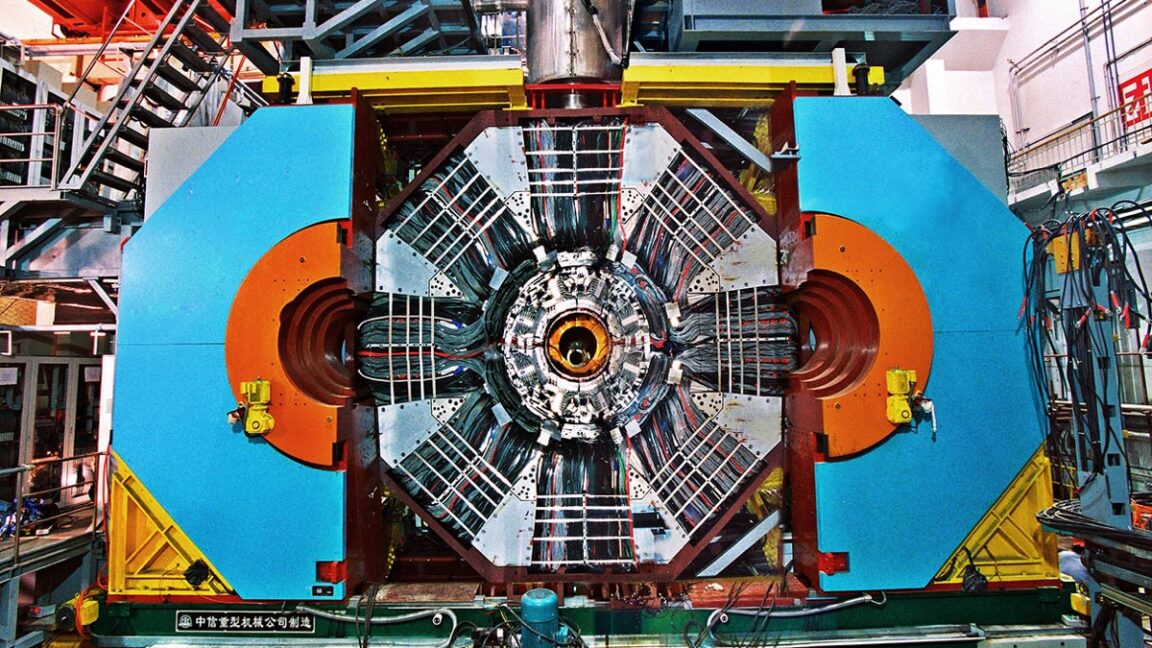
A glueball is a hypothetical composite particle composed entirely of gluons, the force-carrying particles of the strong nuclear force. While the Standard Model of particle physics predicts that these particles must exist to maintain the stability of the strong force, they have remained elusive in experimental settings for decades. Recent data from the Beijing Spectrometer III (BES III) experiment provides some of the most compelling evidence to date that these particles are real.
According to the Standard Model, gluons are responsible for holding quarks together to form protons and neutrons. Because gluons carry the strong force, quantum chromodynamics (QCD) dictates that they should be able to interact with one another to form bound states. These bound states, devoid of quarks, are what physicists identify as glueballs. If confirmed, the detection of glueballs would provide a critical validation of the mathematical framework governing the strong nuclear force.
The discovery of glueballs is significant because it serves as a fundamental test of quantum chromodynamics, the theory describing the strong nuclear force. While the Higgs boson completed the Standard Model's description of mass, the existence of glueballs confirms that the strong force can manifest as matter without the presence of quarks. Validating this prediction reinforces our current understanding of how the universe is held together at the subatomic level.
For years, physicists have relied on mathematical simulations to predict the properties of glueballs, such as their mass and decay patterns. However, experimental confirmation has been difficult because glueballs are unstable and decay rapidly into other particles. The BES III results presented at the International Conference on High Energy Physics (ICHEP) indicate a specific resonance that matches theoretical predictions for a scalar glueball, suggesting that experimental technology has finally caught up to theoretical requirements.
The Beijing Spectrometer III (BES III) experiment detects glueballs by colliding electrons and positrons at high energies to produce J/psi mesons. These mesons act as a laboratory for studying the strong force; when they decay, they produce a high density of gluons. Researchers analyze the debris from these collisions to identify excess energy signatures that do not correspond to known quark-based particles, which are then categorized as potential glueball candidates.
Keep exploring
More from Groundwork
- Particle collisions: Researchers collide electron-positron pairs within the BES III detector to generate J/psi mesons.
- Decay analysis: As these mesons decay, they release a shower of secondary particles.
- Data filtering: Physicists isolate the decay products that lack quark signatures, focusing on specific energy resonances.
- Statistical validation: The team compares the observed resonance patterns against QCD predictions to determine if they align with the expected properties of a glueball.
The next steps for confirming the existence of glueballs involve independent verification by other high-energy physics experiments, such as those at CERN or other international facilities. While the BES III findings are compelling, the scientific community requires multiple, independent observations of the same resonance patterns to rule out systematic errors or alternative explanations within the complex environment of particle collisions.
Researchers are now focusing on refining the data analysis to reduce background noise, which often obscures the signal of new particles. By increasing the luminosity of the collider and improving detector resolution, physicists expect to capture cleaner data sets that can conclusively distinguish a glueball from other, more common subatomic phenomena. If the signal remains consistent across different experimental setups, it will effectively move the glueball from the category of "theoretical prediction" to "empirically observed particle."
These findings suggest that our understanding of the strong force is largely accurate, but they also open doors to new research regarding the vacuum state of the universe. Because glueballs are essentially "pure force" held together by its own intensity, studying them provides insight into the nature of confinement—the process by which gluons prevent quarks from ever existing in isolation. Understanding this mechanism is essential for developing a more complete theory of physics that might eventually bridge the gap between quantum mechanics and gravity.