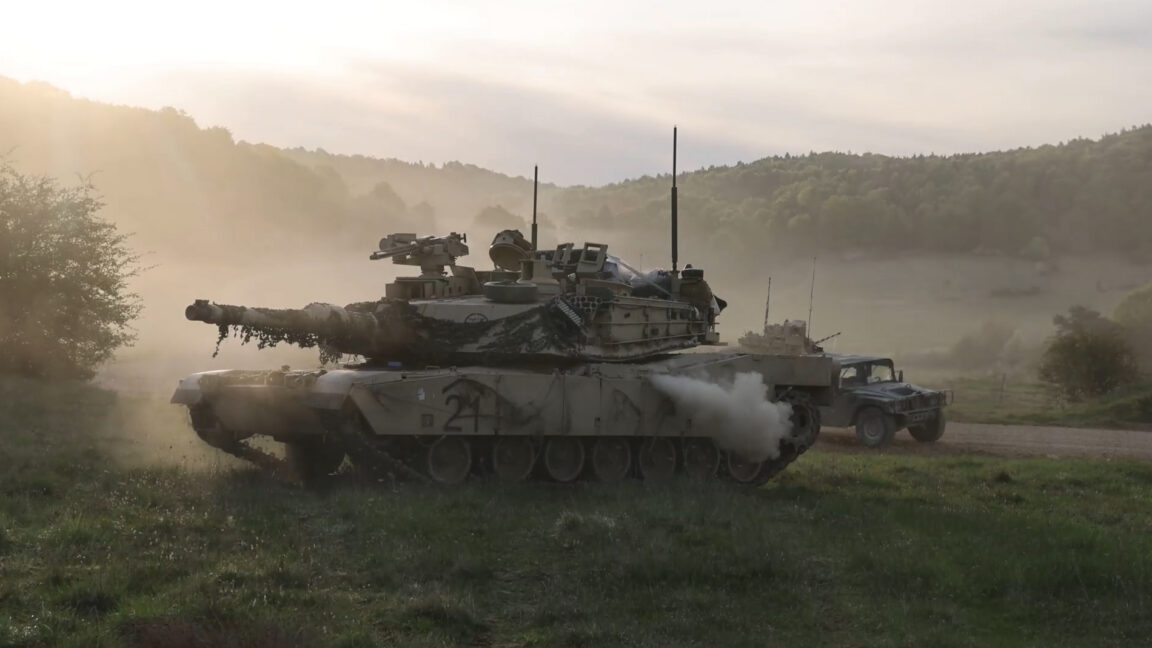
Modern drone warfare is the use of unmanned aerial vehicles (UAVs) to conduct reconnaissance, surveillance, and precision strikes against enemy targets. Recent military exercises, such as the Combined Resolve drills in Germany, demonstrate that small, low-cost drones can neutralize high-value armored assets, including main battle tanks, by exploiting vulnerabilities in traditional ground combat formations.
During these simulations, Ukrainian drone operators—drawing on direct experience from active combat—successfully targeted US Army armored units. The speed at which these drones identified and "destroyed" tanks suggests that current tactical doctrines for armored warfare require urgent revision to account for the persistent threat of aerial observation and strike capability.
Small, inexpensive drones are highly effective against tanks because they provide an asymmetric advantage, allowing operators to locate and strike vulnerable areas like engine decks or top-mounted sensors from angles traditional anti-tank weapons cannot easily reach. According to reports from the Combined Resolve exercise, the low radar cross-section and thermal signature of these drones make them difficult for standard vehicle-mounted defensive systems to detect and engage in real-time (The Wall Street Journal, 2026).
Because tanks are designed primarily to withstand kinetic energy penetrators and chemical energy warheads fired from other ground vehicles, their top-down protection is often insufficient against precision-guided drone munitions. This shift in battlefield dynamics means that a relatively cheap drone, costing a fraction of a main battle tank, can effectively remove a multimillion-dollar asset from the fight.
In military simulation, "respawning" is a training method where destroyed assets and personnel are immediately reintroduced into the exercise to allow soldiers to continue practicing maneuvers and decision-making despite sustaining catastrophic losses. By utilizing this method, US Army leadership allowed troops from Fort Hood, Texas, to analyze their failures in real-time rather than ending the exercise prematurely due to simulated destruction.
This approach provides several pedagogical benefits for modern training:
Keep exploring
More from Groundwork
- High-stress repetition: Soldiers gain experience in high-attrition environments without the logistical constraints of a real combat loss.
- Tactical adjustment: Units can test alternative camouflage, dispersion patterns, and electronic warfare countermeasures to see if they improve survivability against drone swarms.
- Data collection: Evaluators can quantify the effectiveness of specific drone tactics, which informs future procurement and doctrine development.
The success of drone tactics in current war games indicates that armored units must prioritize electronic warfare (EW) and integrated air defense systems at the platoon level to survive in modern conflict. If a brigade cannot mask its electromagnetic signature or jam incoming drone signals, it becomes a static target for precision strikes, regardless of its superior armor or mobility.
Military analysts suggest that the future of armored warfare will likely shift toward:
- Increased dispersion: Reducing the density of vehicles to make them harder targets for small drone teams.
- Dedicated counter-UAS assets: Equipping every tactical unit with portable jamming technology or directed-energy weapons to neutralize drones before they reach the strike zone.
- Collaborative robotics: Integrating friendly drones into armored formations to provide early warning and counter-reconnaissance capabilities.
To mitigate the risk posed by inexpensive drones, military organizations are moving toward a "layered defense" approach that combines traditional kinetic interceptors with sophisticated digital warfare tools. The lessons learned from exercises like Combined Resolve suggest that the focus must shift from heavy physical protection to situational awareness and signal suppression.
If you are interested in how these technological shifts impact national security and defense procurement, monitor updates from the Department of Defense regarding the integration of counter-UAS systems into standard infantry and armored brigades. As these technologies evolve, the ability to deny the enemy the use of the electromagnetic spectrum will become as critical as the ability to fire a main gun.